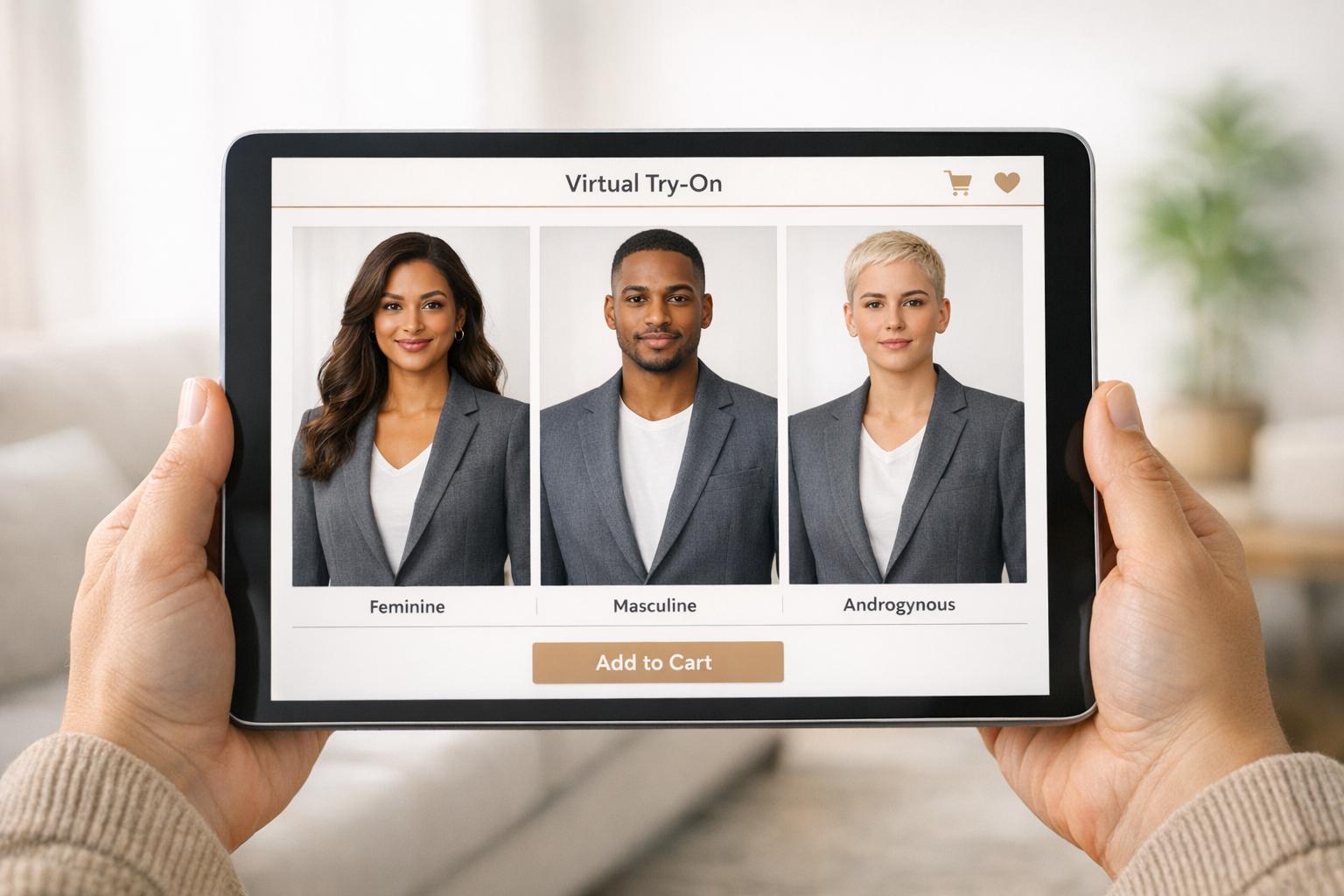
42% of online shoppers feel underrepresented by e-commerce imagery, and 59% are dissatisfied when products don’t meet expectations. This lack of representation leads to higher return rates – over 20% of online purchases in the U.S. were returned in 2022, causing financial losses and environmental harm. Gender-inclusive AI models offer a solution by showcasing products on diverse body types, skin tones, and gender expressions, helping shoppers visualize items more accurately.
These AI tools use advanced technology, like diffusion models, to create realistic images of clothing on various body types, reducing the need for expensive photoshoots and addressing biases in traditional marketing. For example, Google’s virtual try-on feature uses data from 80 diverse models to generate photorealistic visuals, which 93% of users rated as highly accurate. This approach improves customer confidence, reduces returns, and increases loyalty.
Platforms like PixelPanda make this technology accessible, offering customizable AI avatars and virtual try-ons starting at $39/month. However, challenges remain, including reducing bias in AI training data and ensuring transparency with customers. Businesses that adopt these tools can create more representative shopping experiences while saving time and money.
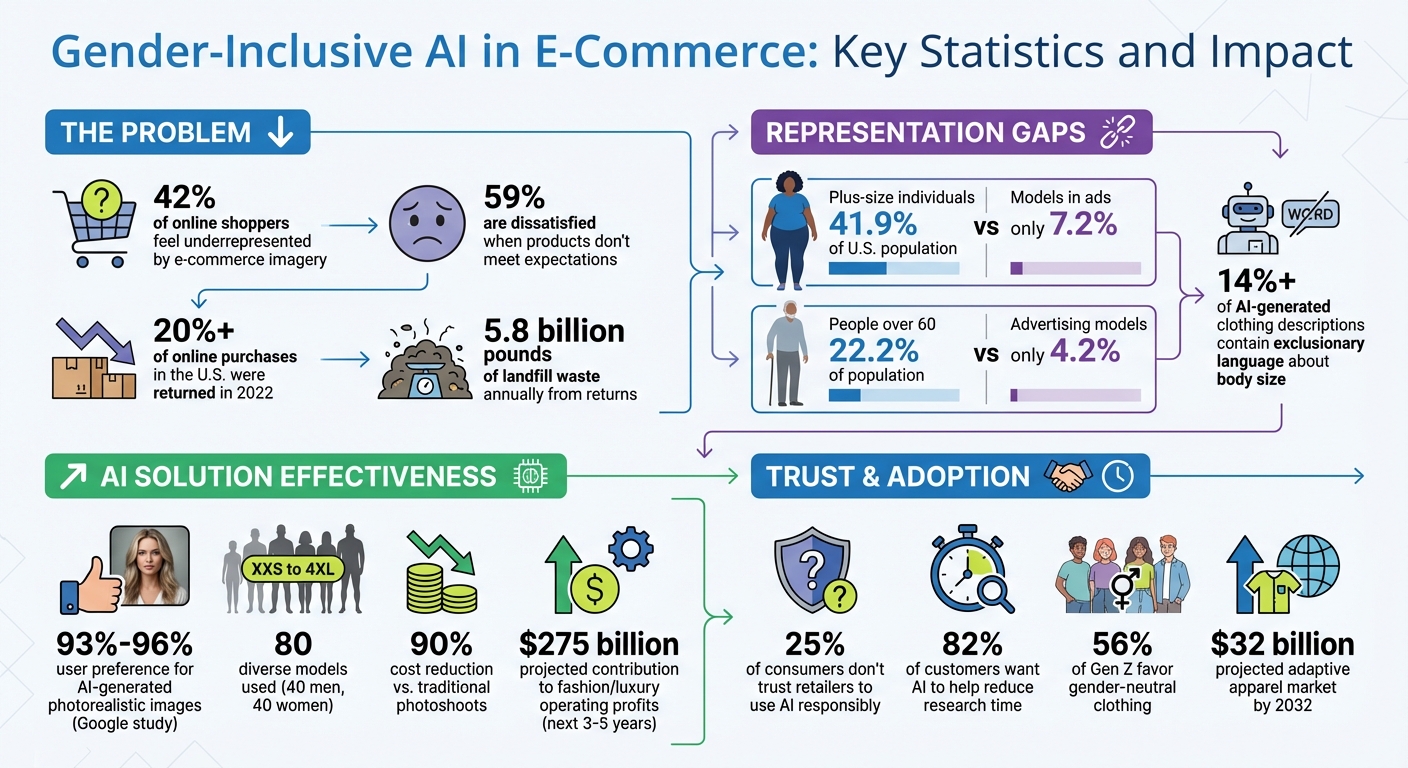
Gender-Inclusive AI in E-Commerce: Key Statistics and Impact
AI-generated models shake up the fashion industry and raise concerns
What Are Gender-Inclusive AI Models?
Gender-inclusive AI models are generative systems designed to reflect a wide range of gender expressions, body types (from XXS to 4XL), ethnicities, and skin tones. Unlike traditional e-commerce photography, which often relies on a small group of professional models, these AI tools allow products to be showcased on a much broader spectrum of appearances. This helps shoppers better visualize how clothing might look on them personally.
Rather than using outdated methods like compositing garments onto static silhouettes – which often leads to distorted or unrealistic results – these models employ diffusion techniques. This approach creates photorealistic images that realistically show how fabric drapes, folds, and casts shadows on different body types.
"Our new generative AI model can take just one clothing image and accurately reflect how it would drape, fold, cling, stretch, and form wrinkles and shadows on a diverse set of real models in various poses."
– Lilian Rincon, Senior Director of Product, Shopping, Google
The process relies on a cross-attention mechanism between two neural networks: one analyzes the garment, while the other focuses on the person. These systems are trained on massive datasets containing millions of image pairs, ensuring they can accurately represent a variety of body types and skin tones. For instance, Google’s virtual try-on tool was developed using a diverse group of 80 real models (40 men and 40 women) ranging from XXS to 4XL, with skin tones measured by the Monk Skin Tone Scale.
This technology not only enhances inclusivity but also addresses key challenges faced by e-commerce platforms.
Key Features of Gender-Inclusive AI Models
These advanced models bring several standout features that are particularly beneficial for online shopping.
One major feature is the ability to create customizable avatars. Shoppers can either match models to their own appearance or upload personal photos for a more personalized virtual try-on experience. Additionally, the models provide diverse demographic representation, offering retailers a more effective way to connect with a broader audience.
The system requires only high-resolution images (512×512 pixels) of garments, whether displayed on mannequins, laid flat, or photographed front-facing. From there, it generates multiple stylistic variations. In user studies testing Google’s "TryOnDiffusion" technology, participants rated the AI-generated visuals as the most accurate representation in 93% to 96% of cases.
These features make gender-inclusive AI models a game-changer for creating more relatable and realistic shopping experiences.
Why E-Commerce Needs Gender-Inclusive AI Models
E-commerce has a glaring issue with representation. Many shoppers feel disconnected due to a lack of diversity in how products are showcased, which often leads to unmet expectations and dissatisfaction. This isn’t just a minor inconvenience – it’s a problem that affects sales and customer loyalty.
And it’s not just about visuals. The way products are described also plays a big role in shaping consumer perceptions. When AI models repeatedly display clothing on limited body types or rely on stereotypical language, they reinforce exclusionary norms. For instance, research shows that over 14% of AI-generated clothing descriptions included language that alienates certain body sizes. Additionally, GPT-3.5 was found to generate "calls to action" like "order now!" 5.5 percentage points more often for men’s products than women’s. These subtle biases in language and imagery can alienate entire groups of shoppers.
Trust is another major concern. Nearly 25% of consumers don’t trust retailers to use AI responsibly. As Jan Wittrodt, Director of Privacy, AI and Technology Law at Zalando, explained:
"This is a business that’s about trust and if you get this wrong because you get your AI wrong, then you have a negative impact and you lose your customers." – Jan Wittrodt, Director of Privacy, AI and Technology Law at Zalando
Improving Customer Engagement with Inclusive Visuals
When shoppers see products modeled on people who resemble them, it’s a game changer. They feel more confident in their choices, which leads to better purchase decisions. A great example of this is Good American’s October 2022 feature that allowed customers to select a "preferred model" on product pages. Shoppers could choose between models like "Katie", "Charlotte", or "Rachel", each representing different body types and measurements. This level of personalization made it easier for customers to visualize how items would fit, reducing the guesswork – and the returns.
"When users see products on people that look like them, they become more confident in their purchase decisions and, thus, are more likely to purchase and later return to the site." – Kim Flaherty, Senior User Experience Specialist, Nielsen Norman Group
This approach doesn’t just improve individual transactions. It reduces choice overload, curbs cart abandonment, and builds long-term loyalty. Shoppers who feel represented are more likely to revisit a site and recommend it to others.
Reducing Bias in Marketing
Traditional e-commerce marketing has long been guilty of perpetuating harmful stereotypes. For example, plus-size individuals represent 41.9% of the U.S. population, but only 7.2% of models in ads are plus-sized. Similarly, while people over 60 make up 22.2% of the population, they account for just 4.2% of advertising models. These disparities send a clear message about who is – and isn’t – welcome in the marketplace.
AI systems trained on biased historical data often reinforce these patterns. Women are frequently associated with domestic products, while men are linked to work-related or "problem-solving" items. Even persuasive language tends to favor men’s products over women’s. Gender-inclusive AI models can help break this cycle by making it easier and more cost-effective to showcase products on a diverse range of bodies and eliminate biased messaging.
One promising example comes from Google Shopping. In June 2023, they introduced a virtual try-on feature for women’s tops in the U.S., partnering with brands like H&M, Anthropologie, Everlane, and Loft. This tool used 80 real models – 40 men and 40 women – spanning sizes XXS to 4XL. It was a step forward in addressing representation gaps.
These efforts to reduce bias not only improve customer trust but also set the stage for broader benefits. Tackling these challenges strengthens consumer relationships and highlights the practical advantages of adopting gender-inclusive AI models.
Benefits of Gender-Inclusive AI Models for E-Commerce
Cost and Time Savings
Traditional photoshoots can be a financial drain, with expenses piling up for casting, model fees, travel, studio rentals, and post-production editing. Gender-inclusive AI models slash these costs by as much as 90%. Instead of organizing multiple photoshoots, brands can instantly create diverse visuals using AI.
The time savings are just as impactful. Generative AI is projected to contribute up to $275 billion to the operating profits of the fashion and luxury industries within the next three to five years. This efficiency allows brands to accelerate product launches, refresh seasonal catalogs without reshooting, and test marketing campaigns across various demographics. And as a bonus, this streamlined process supports broader inclusivity efforts.
Better Inclusivity and Representation
Gender-inclusive AI models go beyond saving money and time – they transform representation in e-commerce. These tools make it possible to showcase products on a wide variety of body types and appearances, all while keeping costs manageable.
Take Google’s virtual try-on feature, launched in June 2023, as an example. It highlighted 80 real models – 40 men and 40 women – spanning sizes from XXS to 4XL, with diverse skin tones and ethnic backgrounds. Partnering with brands like H&M, Anthropologie, Everlane, and Loft, Google used tools such as the Monk Skin Tone Scale to ensure a broad and objective range of skin tone representation. Achieving this level of diversity with traditional photography would have been prohibitively expensive.
Better Customer Experience with Virtual Try-Ons
Returns are a huge issue in online shopping – U.S. consumers sent back more than 20% of all online purchases in 2022. Virtual try-ons powered by gender-inclusive AI models offer a solution.
For instance, Google’s "TryOnDiffusion" technology uses diffusion models to create photorealistic images that show how clothing fits, drapes, and stretches on different body types. This level of detail boosts shopper confidence and helps cut down on returns. In fact, in user studies, participants chose these AI-generated images as the most accurate option 93% of the time. As Ira Kemelmacher-Shlizerman, Principal Scientist at Google Shopping, put it:
"We were committed to generating every pixel of a garment from scratch to produce high-quality, realistic images. We found a way with our new diffusion-based AI model."
When shoppers see products modeled on bodies that resemble their own, they feel more confident in their purchase decisions. It’s no wonder that 82% of customers want AI to help them spend less time researching what to buy. This technology delivers a more personalized and efficient shopping experience, making online shopping feel tailored to individual needs.
sbb-itb-76ad1b7
PixelPanda: Tools for Creating Gender-Inclusive Visuals

Customizable AI Models for Diverse Representation
PixelPanda brings together tools like background removalixelpanda.ai/free-tools/background-remover”>background removal, upscalinghttps://pixelpanda.ai/free-tools/enhance-photo”>upscaling, and generative AI to make creating inclusive visuals a seamless process. One standout feature is the AI Avatar studio, which enables brands to generate virtual try-on models. This allows apparel to be showcased on a variety of body types – no need for hiring physical models or organizing elaborate photoshoots.
"The AI Avatar studio is another game-changer, allowing brands to generate infinite professional headshots or create virtual try-on models for fashion, reducing the need for expensive and time-consuming photoshoots." – PixelPanda
The virtual try-on function not only improves how garments are visualized but also promotes inclusivity, which can help drive higher conversion rates. Additional tools, like outfit swapping and product holding, provide even more ways to authentically represent diverse audiences. Meanwhile, the background removal tool excels at handling tricky details like hair and fur, ensuring polished results every time.
For businesses handling large-scale production, PixelPanda’s API-first design simplifies creating thousands of brand-consistent assets. Whether it’s social media banners, product cutouts, or seasonal catalogs, the platform is built to support high-volume needs while maintaining inclusivity across all visuals.
Pricing Plans for Different Business Sizes
PixelPanda offers flexible, credit-based pricing plans that cater to businesses of all sizes, making it easier to manage costs while benefiting from AI-powered content creation.
Here’s a breakdown of the three main pricing tiers:
- Starter Plan: $39/month (billed annually) with 7,000 credits – enough for 350 videos or 7,000 images.
- Growth Plan: $59/month with 15,000 credits, covering up to 750 videos or 15,000 images.
- Pro Plan: $89/month with 35,000 credits, ideal for 1,750 videos or 35,000 images.
All plans include advanced features like product holding, outfit swapping, and multilingual video voiceovers in 35 languages. For those curious to try it out, PixelPanda offers a free trial with 10 credits – no credit card required. Keep in mind that credits don’t roll over, so selecting a plan that aligns with your regular production needs is key.
Challenges and Ethical Considerations
Ensuring Fair Representation
AI models rely heavily on the data they are trained on, and when that data lacks diversity, the outcomes often reflect those gaps. One significant challenge is representation bias. Datasets frequently lean toward dominant groups, leaving marginalized communities underrepresented. Additionally, human annotators can unintentionally inject their own stereotypes into the data.
A notable example of addressing this issue occurred in January 2024, when Adobe’s Product Equity team, under the leadership of Principal Product Manager Julianna Rowsell, introduced a set of targeted prompts for Adobe Firefly. This initiative aimed to reduce stereotypical imagery and improve representation across various demographics, including race, ethnicity, body type, and age. Similarly, a 2024 study analyzing 10,000 AI-generated descriptions on eBay revealed that GPT-3.5 included "calls to action" (e.g., "order now!") 5.5 percentage points more often for men’s products compared to women’s products.
Bias can become a self-reinforcing cycle. For instance, when AI produces biased content and users engage with it without challenging the bias, those interactions feed back into the system, perpetuating and amplifying the problem in future iterations. A study highlighted this feedback loop, showing that over 14% of clothing descriptions generated by an e-commerce-specific language model contained exclusionary language about body size. Tackling these biases is critical, particularly when incorporating AI into workflows that require human oversight.
Balancing AI and Human Models
Addressing bias is just one part of the equation; ensuring a balanced integration of AI and human input is equally important. AI should enhance, not replace, human contributions. Trust plays a pivotal role here – nearly 25% of people report skepticism about retailers using generative AI responsibly. Being transparent about when and how AI-generated content is deployed is essential for maintaining consumer confidence.
"This is a business that’s about trust and if you get this wrong because you get your AI wrong, then you have a negative impact and you lose your customers, you lose your partners." – Jan Wittrodt, Director of Privacy, AI and Technology Law, Zalando
Striking this balance helps preserve authenticity and ensures consumers feel confident in the brands they engage with. A "human-in-the-loop" approach – where humans oversee and guide AI processes – can provide necessary checks and safeguards. Involving workers, unions, and labor organizations during AI development can also help identify risks to labor rights and economic stability.
An example of this approach in action is Zalando’s virtual fitting room, launched in April 2025. Spearheaded by Tian Su, VP of Personalization and Recommendation, this feature allows customers to create 3D avatars based on their actual body measurements. By addressing size-and-fit challenges, this initiative offers a more inclusive and personalized shopping experience compared to traditional models. AI can open up new opportunities, but it must do so in a way that complements the human touch and maintains authenticity.
How to Implement Gender-Inclusive AI Models in Your E-Commerce Business
Selecting the Right Tools
Choosing the right platform is the first step toward creating inclusive and realistic visuals for your e-commerce business. Look for platforms that use diffusion-based models, which rely on iterative denoising techniques to simulate how fabrics naturally drape, fold, and stretch across a variety of body types. These tools not only enhance realism but also reduce the risk of ethical concerns and potential backlash by focusing on digitally dressing real human models instead of relying solely on synthetic, AI-generated characters.
One example is PixelPanda’s AI Fashion Studio. This platform provides customizable AI models that represent a broad range of body types and ethnicities, making it easier to connect with your diverse customer base. Features like virtual try-ons and avatar-based photo packs with commercial usage rights allow businesses to create visuals that resonate with their audience. Plans start at $39/month for 7,000 credits, which translates to 350 videos and 7,000 images – an affordable option for businesses of all sizes.
It’s also important to educate your team about the differences between generative and predictive AI while maintaining transparency with customers about AI-generated content. Once you’ve selected the right tools, focus on customizing avatars to reflect the diversity of your target audience.
Customizing Avatars for Your Target Audience
To ensure your avatars truly represent your customer base, start by implementing standardized diversity scales like the Monk Skin Tone Scale. This helps provide robust representation across a wide range of skin tones. Additionally, your selection of avatars should span sizes from XXS to 4XL and include variations in hair types, ethnicities, and body shapes.
Major retailers have already seen success with customizable avatars. For example, some platforms have transitioned from using 80 real human models to enabling customers to create full-body digital avatars from just a selfie. This level of personalization addresses a pressing issue: 42% of online shoppers feel underrepresented by standard e-commerce imagery, and 59% report dissatisfaction with purchases due to discrepancies between product visuals and actual fit.
Providing customers with the ability to choose models that reflect their identity can also tap into the Proteus Effect – a phenomenon where users’ behavior in virtual spaces is influenced by the appearance of their digital avatars. To maintain and improve this inclusivity, regular testing for bias is essential.
Testing and Improving for Bias Reduction
Bias testing should be a continuous process. Start by conducting adversarial testing (also known as red teaming), where you input stereotypical prompts to identify biased or problematic outputs. Use a three-tier impact analysis to classify results as Minimal, Moderate, or High bias.
For example, in January 2024, Adobe’s Product Equity team enhanced its Firefly generative AI model by analyzing over 3,700 pieces of feedback and 50,000 images. They discovered that searches for terms like "drag queen" often produced inconsistent or stereotypical results. In response, they developed a curated test suite that explored gender identity, resulting in more diverse representations across race, age, and body type.
Human oversight plays a critical role in this process. Regularly review AI outputs for technical issues, such as "leaking", where elements from one image improperly appear in another. Pay attention to preserving individual characteristics like tattoos or muscle structure. Additionally, ensure feedback mechanisms are easy to find within your platform’s interface so users can quickly report bias or other concerns.
"Equitable and ethical model development requires active work with human monitors, and technology stack mitigation efforts to ensure key intervention points for harm reduction." – Julianna Rowsell, Principal Product Manager, Product Equity, Adobe
Conclusion
Gender-inclusive AI models are becoming a game-changer for e-commerce businesses aiming to remain competitive. These tools tackle representation gaps head-on while addressing issues like costly returns, which contribute to an estimated 5.8 billion pounds of landfill waste annually.
Google’s introduction of a virtual try-on tool in June 2023 demonstrated how diffusion-based AI can accurately replicate garment draping, with users preferring these photorealistic images 93%–96% of the time. Leading retailers are already using such technology to elevate customer experiences.
Now, these advancements are more accessible than ever. Platforms like PixelPanda’s AI Fashion Studio make it easy for businesses of all sizes to integrate this technology. Starting at $39/month for 7,000 credits (enough for 350 videos and 7,000 images), businesses can create customizable AI models that showcase diverse body types and ethnicities – all without the hefty costs of traditional photoshoots. With features like virtual try-ons and avatar-based photo packs that include commercial usage rights, brands can connect authentically with a broader audience.
To implement these tools effectively, focus on diffusion-based models that genuinely represent human diversity. Involve diversity experts from the start, maintain transparency about AI-generated content, and continuously test for bias. As Nadia Boujarwah, CEO of Dia & Co, wisely points out:
"The worst danger would be for AI to pick up on all the biases that are so deeply entrenched in what we do, but if we consciously reverse those biases systematically, that’s the most exciting outcome of all".
With the adaptive apparel market projected to hit $32 billion by 2032 and 56% of Gen Z already favoring gender-neutral clothing, embracing these innovations isn’t just about meeting customer expectations – it’s about setting a new benchmark for inclusivity in e-commerce.
FAQs
How can gender-inclusive AI models help e-commerce businesses reduce product returns?
Gender-inclusive AI models are transforming how e-commerce businesses handle product recommendations. By delivering personalized suggestions that consider diverse customer identities, body types, and preferences, these models help ensure customers receive items that align more closely with their expectations. This can significantly reduce common issues like incorrect sizing or poor fit.
By catering to a broader spectrum of customer needs, these AI-driven tools not only improve the shopping experience but also help businesses cut down on product returns. The result? Less time and money spent on returns and a boost in customer loyalty.
What ethical factors should businesses consider when using AI for gender inclusivity?
When using AI to promote gender inclusivity, businesses need to zero in on three key principles: fairness, transparency, and privacy. Without careful attention, AI systems can unintentionally amplify gender biases, especially if they’re trained on data that isn’t balanced or representative. To counter this, developers should rely on diverse datasets and incorporate bias-reduction strategies to ensure outcomes are equitable.
Equally crucial is transparency. Companies should be upfront about how their AI models operate, particularly when tackling sensitive issues like gender representation. Clear communication builds trust and gives stakeholders the opportunity to assess and, if necessary, question the system’s decisions.
Privacy is another non-negotiable. AI often requires vast amounts of personal data, making it essential for businesses to handle this information responsibly. Protecting user data from misuse or breaches not only safeguards individuals but also strengthens trust in the technology. By sticking to these ethical principles, companies can develop AI tools that promote inclusivity while maintaining user confidence and fostering fairness in e-commerce.
How can businesses create gender-inclusive AI models and avoid bias?
To build AI models that respect gender inclusivity and reduce bias, businesses need to adopt thoughtful and proactive strategies. A key step is training AI systems with datasets that are diverse and truly representative. This helps prevent the reinforcement of harmful stereotypes and ensures a broader, more accurate reflection of society.
Another crucial practice is to conduct regular audits and tests throughout the AI lifecycle, from development to deployment. This helps identify and address any unintended biases before they can cause harm.
Equally important is incorporating inclusive design principles and involving team members from a variety of backgrounds in the development process. A diverse team brings in multiple perspectives, making it more likely the AI will cater to a wider audience. These practices are especially impactful in industries like e-commerce, where fairness and representation play a direct role in building customer trust and loyalty.