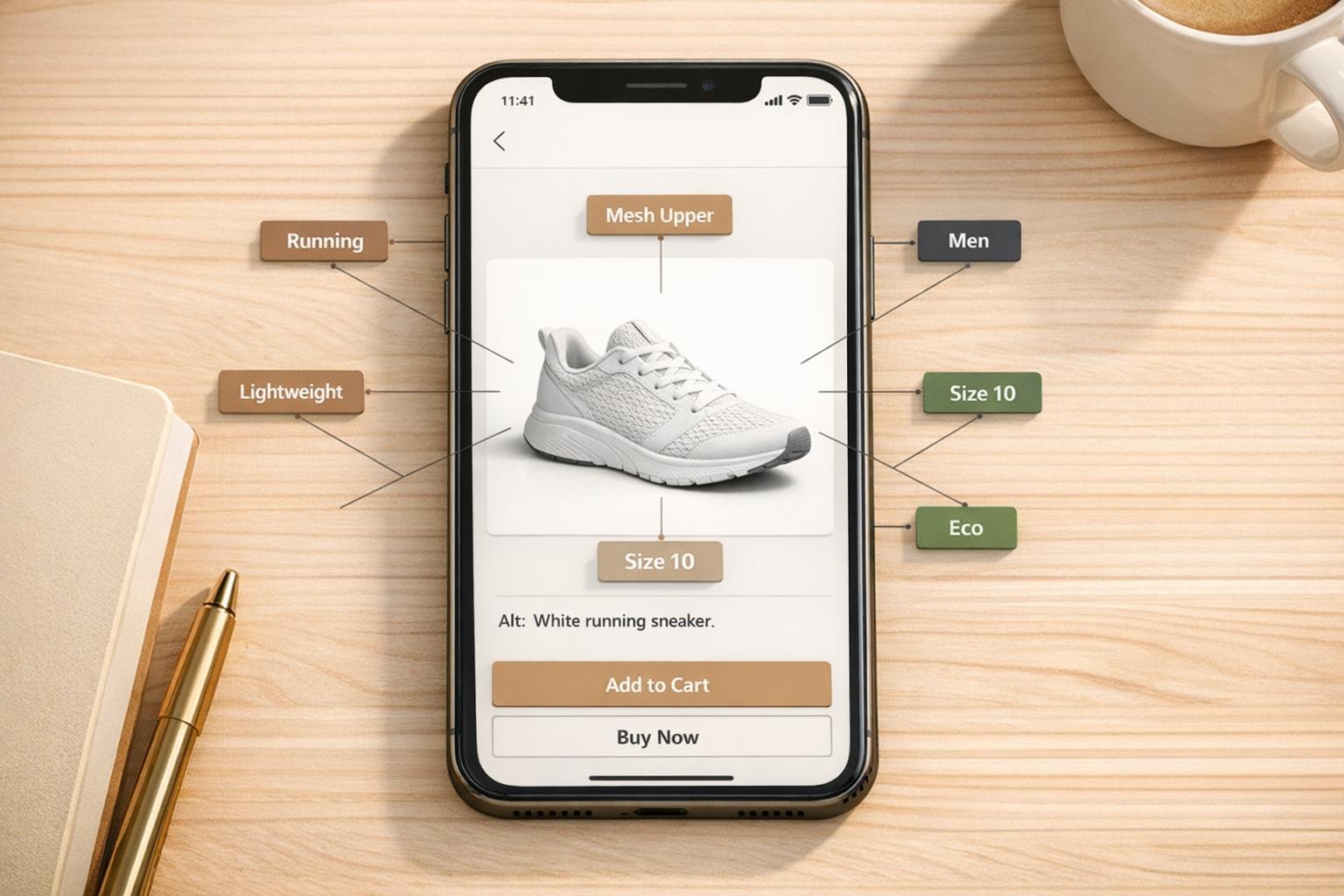
AI product tagging is transforming e-commerce SEO by automating how product details are labeled and optimized for search engines. Here’s what you need to know:
- Why it matters: With 87% of shoppers starting their search online and nearly 50% using AI tools, your product listings need to rank in both traditional search engines and AI-generated answers.
- What it does: AI scans product images and descriptions to create detailed, structured metadata (like keywords, alt-text, and Schema markup) that improve visibility and search accuracy.
- Benefits:
- Boosts search rankings by aligning product tags with user intent.
- Enhances shopper experience by improving on-site search filters and reducing bounce rates.
- Saves time by automating tagging for large inventories, including synonyms and trend-specific keywords.
- Key features to optimize: Title tags, meta descriptions, alt-text, and product attributes like fabric type, style, and certifications.
- How to implement: Use AI tools with visual recognition, integrate them via APIs, and customize tags for mobile and global markets.
With e-commerce sales projected to hit $6.5 trillion, AI-powered tagging is no longer optional – it’s a must for staying competitive in a fast-evolving market.
GPT-4.1 is Crazy! | Auto-Tag E-commerce Products with AI | LangChain + Python Tutorial
SEO Benefits of AI-Powered Product Tagging
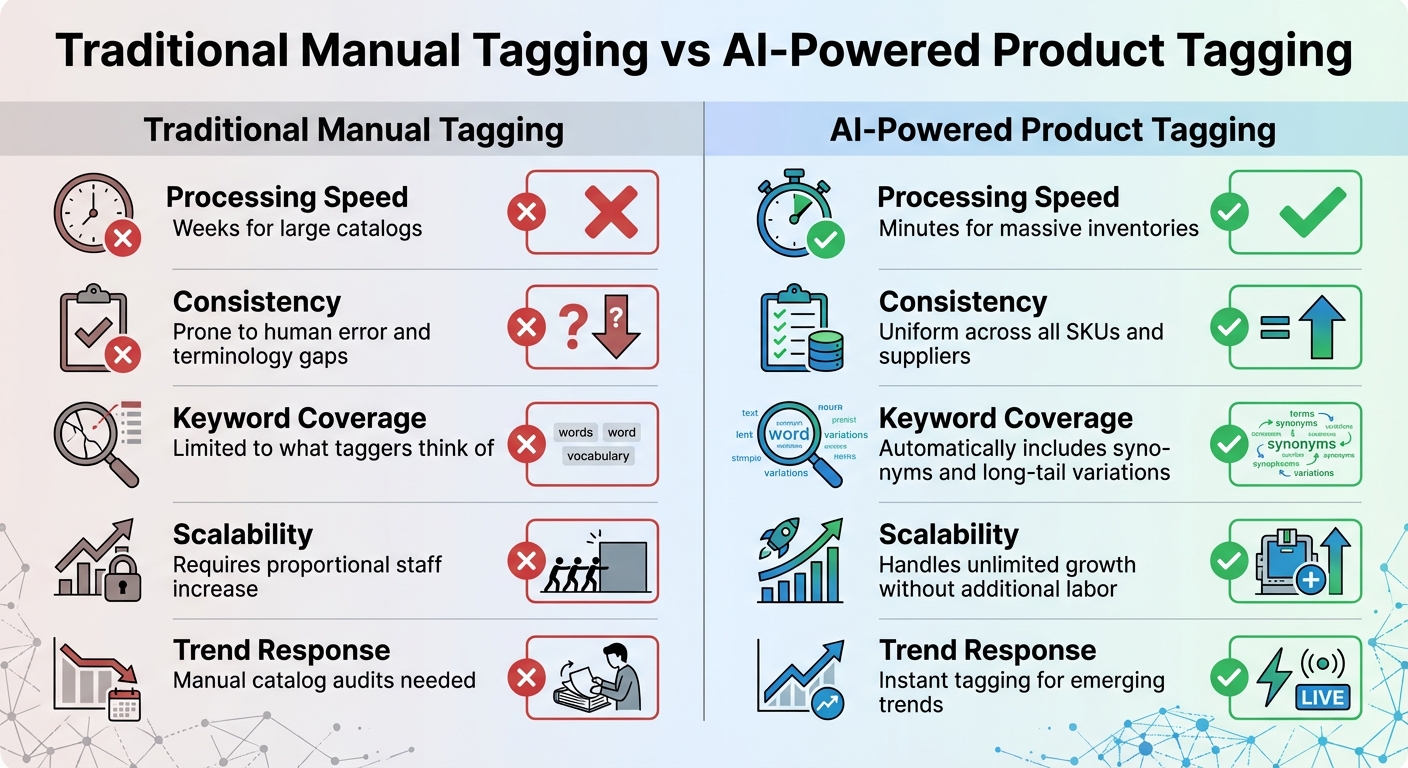
AI-Powered vs Traditional Manual Product Tagging Comparison
Better Search Engine Visibility
AI brings a deeper understanding of search intent and context, significantly broadening your product’s reach. For example, when a shopper searches for "eco-friendly laptop bag", AI can interpret the intent behind the query – recognizing a preference for sustainable materials or certifications – even if those exact terms aren’t in your product title. This capability ensures your products appear in a wider range of relevant searches.
Long-tail queries also benefit from AI’s ability to create natural, descriptive titles. Think about a product labeled as "Women’s Waterproof Trail Running Shoes – Lightweight, Breathable, Blue." Titles like this reflect how people naturally speak, which aligns perfectly with the 30% of younger shoppers who now use AI for discovering products.
Visual AI adds another layer by identifying details like hardware finishes or fabric textures, which are often overlooked during manual tagging. These details are embedded into alt-text and metadata, boosting your product’s visibility. AI also automates Schema markup for key product details like pricing, availability, and reviews – making it easier for search engines to display your products accurately.
"If your products don’t appear within the AI-generated answer, you’ve lost the vast majority of potential traffic." – Hashmeta
These optimized search signals not only increase visibility but also encourage higher engagement from visitors once they land on your site.
Better User Experience and Lower Bounce Rates
Improved visibility is just the beginning – AI-powered tagging also enhances the shopping experience. By bridging the gap between how products are described and how customers search, AI ensures better matches. For instance, if someone searches for "blue jeans" but your inventory is tagged as "navy denim", AI ensures those products still appear, avoiding the dreaded "no results" page that often leads to high bounce rates.
Enhanced visual detection also sharpens on-site filters, helping shoppers quickly find styles that match their search terms. For example, AI understands that searches like "party dress" or "summery top" indicate specific styles or occasions, tailoring results to align with shopper intent.
"If a customer searches for a particular style and gets presented with completely unrelated results, it’s likely that they’re going to bounce and never come back. With tagging, search results, suggested styles and the search terms that can be used are all improved." – Pixelz
This refined experience keeps shoppers engaged and reduces the likelihood of them leaving your site in frustration.
Scalability and Time Savings
AI tagging doesn’t just improve SEO and user experience – it also saves time and scales effortlessly. By automating metadata generation across large inventories, AI ensures consistent and error-free tags, allowing your team to focus on more strategic tasks. This automation captures more search variations, tagging items with synonyms like "dress" and "frock" or "sweatshirt" and "winter wear", which manual processes often miss.
Speed is another major advantage. For seasonal or trending items, AI can instantly tag products, streamlining the "shoot-to-site" workflow. This means products are searchable and shoppable almost immediately after being added. For example, when trends like "Barbiecore" or "Festival Season" take off, AI can tag related products across your catalog without requiring time-consuming manual audits.
| Feature | Traditional Manual Tagging | AI-Powered Product Tagging |
|---|---|---|
| Processing Speed | Weeks for large catalogs | Minutes for massive inventories |
| Consistency | Prone to human error and terminology gaps | Uniform across all SKUs and suppliers |
| Keyword Coverage | Limited to what taggers think of | Automatically includes synonyms and long-tail variations |
| Scalability | Requires proportional staff increase | Handles unlimited growth without additional labor |
| Trend Response | Manual catalog audits needed | Instant tagging for emerging trends |
Key Metadata to Optimize with AI Tools
AI tools can turn your product metadata into powerful search drivers. By focusing on title tags, meta descriptions, alt-text, and product attributes, you can significantly improve search visibility and enhance the overall shopping experience.
Title Tags and Meta Descriptions
Title tags are small but mighty – aim to keep them within 50 to 60 characters for maximum impact. AI is particularly effective at creating keyword-rich, on-brand titles for large product catalogs. For example, a title like "Women’s Waterproof Trail Running Shoes – Lightweight, Blue" is much more engaging and click-worthy than a generic one like "women’s waterproof trail running shoes – lightweight, blue". Using Title Case also helps boost click-through rates.
Meta descriptions, on the other hand, should stay between 150 and 160 characters to avoid getting cut off in search results. AI tools can analyze product data to craft engaging summaries that naturally incorporate relevant keywords and calls-to-action. This automation not only saves time but also helps prevent duplicate content issues across thousands of product pages, ensuring every listing is optimized for search engines.
Once you’ve nailed your text metadata, it’s time to focus on your images.
Alt-Text and Image Optimization
Alt-text has evolved from being just an accessibility feature to a key player in SEO – especially on mobile devices, where users encounter 12.5 times more images in search results compared to desktop. With mobile accounting for 72.9% of all e-commerce transactions, optimizing your product images is no longer optional.
AI-powered visual recognition tools can analyze your product photos and generate alt-text that’s both descriptive and keyword-rich. Instead of using redundant phrases like "image of" or "photo of", AI creates meaningful descriptions, such as "navy blue denim jacket with silver hardware and quilted lining".
"Google uses alt text along with computer vision algorithms and the contents of the page to understand the subject matter of images" – Google Search Central
The results can be staggering. HubSpot, for instance, saw a 779% increase in image search traffic – bringing in over 160,000 new visits – after optimizing its alt tags. Similarly, Foot Locker experienced a 228% boost in organic traffic by refining image indexing and earning multi-image snippets in search results. These kinds of improvements can dramatically enhance product discovery.
But the optimization doesn’t stop there. Fine-tuning product attributes can take your search visibility even further.
Product Attribute Tags
AI tools excel at identifying specific product details that are often missed during manual tagging – like unique style features or functional descriptors. These details are then turned into searchable tags that align with the way customers naturally search.
For example, when someone searches for "party dress" or "commuter-friendly bag", AI can interpret the intent behind the query and surface products tagged with relevant attributes [4,6]. AI also bridges the gap with synonym mapping, so a product tagged as both "navy denim" and "blue jeans" will appear in searches regardless of the term shoppers use. This approach minimizes the frustration of "no results" pages.
AI can even add semantic tags like "eco-friendly", "travel-friendly", or "work from home" – categories that traditional tagging systems might overlook. This is especially relevant as 30% of younger shoppers now rely on AI tools to discover products. The type of metadata you prioritize will depend on the product category: for fashion, it might include seasonality and fit; for electronics, compatibility specs and wireless standards; and for B2B items, certifications and lead times. AI simplifies this complexity by creating enriched product feeds that perform well in both traditional search engines and AI-driven recommendation systems.
Using advanced AI tools like PixelPanda can streamline the entire process, ensuring your product metadata is optimized to keep your e-commerce listings competitive and visible in search results.
sbb-itb-76ad1b7
How to Implement AI Product Tagging for E-Commerce
You can implement AI product tagging by choosing the right tool, integrating it with your systems, and ensuring it works seamlessly across all devices.
Choosing the Right AI Tool
Start by selecting an AI tool that uses visual recognition to identify detailed product features like fabric texture or neckline style. It should also handle large volumes of products in real time. Make sure the tool supports SEO best practices, such as structured data, to help your products stand out. With nearly 50% of consumers already using AI for product discovery and decision-making, your metadata needs to align with how shoppers search.
Integration is key. Look for tools with RESTful APIs that can easily connect to your product database and handle batch processing. The most effective platforms understand semantic search, which means they can interpret queries like "eco-friendly laptop bag" instead of just matching exact keywords. Opt for solutions that allow you to customize tag schemas and improve tagging accuracy over time using user feedback. Once you’ve chosen your tool, integrate it with your e-commerce platform to unlock its full potential.
Integrating AI with Your E-Commerce Platform
Start by setting up API authentication to ensure secure communication between your e-commerce platform and the AI service. This might involve generating access tokens or configuring IAM roles. Next, create a root "Catalog" resource to house all your products, and import your product data using identifiers like GTIN, UPC, or internal SKUs.
Use API POST requests to send product images in common formats. The AI system will return structured JSON data with generated titles, descriptions, and keywords. For more advanced needs, you can train the AI with labeled datasets to recognize specific product attributes, such as unique labels or packaging details.
Once your catalog is loaded, set up a Recognition Index and deploy it to an active endpoint for real-time or batch analysis. To keep improving tag accuracy, implement feedback loops that refine the system based on user input. This integration not only enhances your SEO but also ensures your product data stays accurate and up-to-date. After integration, shift your focus to optimizing the system for mobile users and global audiences.
Optimizing for Mobile and Global Markets
Since mobile devices account for a large share of e-commerce transactions, your AI tagging system must work flawlessly on smaller screens. Choose AI models that can recognize images taken on mobile devices, whether they’re shelf photos or user-uploaded pictures. Use responsive images with lazy loading to maintain fast performance on all devices.
For global markets, use AI systems that generate cross-language metadata and recognize international identifiers like GTIN and UPC. Adapt your AI logic to align with regional taxonomies and search habits. For instance, a "sweatshirt" in the US might be referred to as "winter wear" in India or "frock" instead of "dress" in the UK. Regularly review and update tags to reflect seasonal trends or regional events, such as "Festival Season" or popular styles.
To enhance performance, convert images to modern formats like WebP, which is about 30% smaller than JPEGs. Use a Content Delivery Network (CDN) to quickly serve AI-optimized images and metadata to international users. This is especially important because 53% of mobile users will leave a site if it takes more than 3 seconds to load. Tools like PixelPanda can simplify image optimization, ensuring your product visuals load quickly and consistently across all devices and regions.
Measuring the Impact of AI Product Tagging on SEO
To understand how AI product tagging influences SEO, focus on tracking the right metrics. This data will reveal whether your efforts are yielding results and highlight areas that need improvement.
Tracking Key SEO Metrics
Start by monitoring organic traffic to your product and category pages using Google Search Console. This tool helps you see if AI-optimized tags are making your pages more visible in search results. Pages ranking in top organic positions often achieve click-through rates (CTR) of 25–30%. If your AI-generated titles and meta descriptions are compelling, you should notice an uptick in these numbers.
Keep an eye on keyword rankings, especially for long-tail keywords that manual tagging might miss. These can capture more specific search intent. Also, check your bounce rate – a high bounce rate might suggest that your tags aren’t matching user expectations. Evaluate your catalog coverage to ensure most of your products are discoverable by search engines. Don’t forget about Core Web Vitals; even a one-second delay in page load time can cut conversions by 7%.
By tracking these metrics, you can better understand how tagging impacts user engagement and search performance.
Analyzing User Behavior and Conversion Rates
Measure search-generated revenue to see how tagging accuracy translates into sales. Look at how shoppers interact with filters and navigation tools. For example, if attributes like "fabric type" or "neckline style" make it easier for customers to find what they need, you’ll likely see an increase in filter usage.
Pay close attention to "no results" queries. Effective AI tagging should reduce these by accounting for synonyms and related terms, improving both search rankings and user experience.
"Anything you can do to get more people actively searching for your brand and your products can have a carryover effect to how your pages rank for non-branded queries." – Kyle Risley, Senior SEO Lead at Shopify
Additionally, remember that faster-loading pages perform better. A page that loads in one second can achieve a conversion rate five times higher than one that takes 10 seconds.
Continuous Optimization Using Data Insights
Tracking metrics is just the beginning – use the data to fine-tune your strategy. Think of product tagging as an ongoing process. Analyze clickstream data to identify which search queries lead to purchases. Prioritize tags that drive conversions instead of those that only bring in traffic. Maintaining a keyword map can also help you manage primary and secondary keywords for each product page, avoiding keyword cannibalization.
Make it a habit to review Google Search Console weekly to spot any technical SEO issues or shifts in keyword performance. Run A/B tests on AI-generated tags to find the versions that deliver higher CTRs.
"The difference between a good and a great search is the relevance of the results to the customer." – Vue.ai
To keep your SEO strategy aligned with current trends, update tags seasonally. AI tools can identify which product attributes are driving sales, helping you adjust your inventory and marketing tactics to match. Regular data-driven updates ensure your SEO efforts remain effective over time.
Conclusion and Key Takeaways
AI-powered product tagging has become a game-changer for e-commerce SEO. With nearly 50% of consumers relying on AI for product discovery and only about 8% clicking traditional "blue link" search results when AI summaries are available, the shift in user behavior is undeniable.
The advantages of AI tagging are clear: it boosts search visibility with rich, descriptive tags that target long-tail queries, enhances user experience by reducing bounce rates, and allows for the rapid tagging of thousands of SKUs in just minutes. These benefits make it an essential strategy for businesses looking to stay competitive.
To maximize these gains, focus on implementing structured data with complete Schema markup, crafting natural language titles that match conversational search trends, and adding specific use-case tags like "travel-friendly" or "eco-friendly" to tap into emerging semantic searches. Tools like PixelPanda can further enhance your efforts by offering AI-driven solutions for professional-quality product images, virtual try-ons, and optimized backgrounds – features that can drive both engagement and conversions.
Regularly reviewing and updating your tagging strategy is key to staying ahead. Set timeframes, such as quarterly or bi-annual reviews, to adjust tags based on shifting trends and customer preferences. As Generative Engine Optimization (GEO) grows in importance, ensuring your products are discoverable across AI assistants, chatbots, and answer engines is critical.
With global e-commerce sales expected to hit $6.5 trillion – accounting for 22% of all retail sales – investing in AI-powered product tagging isn’t just smart; it’s necessary for capturing a larger share of this expanding market. Fine-tune your catalog, monitor performance metrics, and adapt based on real-world data to stay ahead in the fast-evolving e-commerce landscape.
FAQs
How does AI-powered product tagging enhance e-commerce SEO?
AI-driven product tagging takes e-commerce SEO to the next level by offering more accurate and consistent product categorization. This makes it easier for customers to find exactly what they’re looking for when searching or browsing online, while also boosting a site’s visibility on search engines.
Traditional tagging methods often depend on manual input and simple keyword matching, which can be time-consuming and prone to mistakes. In contrast, AI leverages advanced algorithms to analyze product details and generate highly relevant tags. This not only streamlines the process and minimizes errors but also creates a smoother shopping experience. The result? Better search engine rankings and potentially higher conversion rates.
What AI tools can help optimize product metadata for better e-commerce SEO?
AI tools can make product metadata optimization much easier by automating tasks like product tagging, creating structured data, and generating metadata. For example, AI-driven product tagging assigns precise and descriptive labels to your products. This boosts their visibility in search results and helps customers find what they’re looking for more quickly. Plus, these tools keep tags consistent across large inventories and can adjust to trends or seasonal shifts without extra effort.
Another advantage is structured data optimization, which refines product feeds and supports semantic search, making your items easier to find. Similarly, metadata generation at scale lets you manage extensive catalogs efficiently. On top of that, AI tools that handle tasks like background removalixelpanda.ai/free-tools/background-remover”>background removal or image upscalinghttps://pixelpanda.ai/free-tools/enhance-photo”>upscaling can indirectly improve SEO by ensuring your product images look professional and appealing. Using AI for these processes not only saves time but also improves your store’s discoverability and can lead to increased sales.
How does AI product tagging improve user experience and lower bounce rates on my e-commerce site?
AI-powered product tagging plays a key role in improving how users interact with your site. By accurately organizing and categorizing products, it ensures customers can quickly locate what they need. This smoother navigation experience minimizes frustration, keeps users engaged longer, and helps reduce bounce rates.
When AI generates precise and consistent tags, your product listings align better with search queries. This boosts visibility and attracts more targeted traffic. The result? A more enjoyable shopping experience that builds customer satisfaction and loyalty over time.