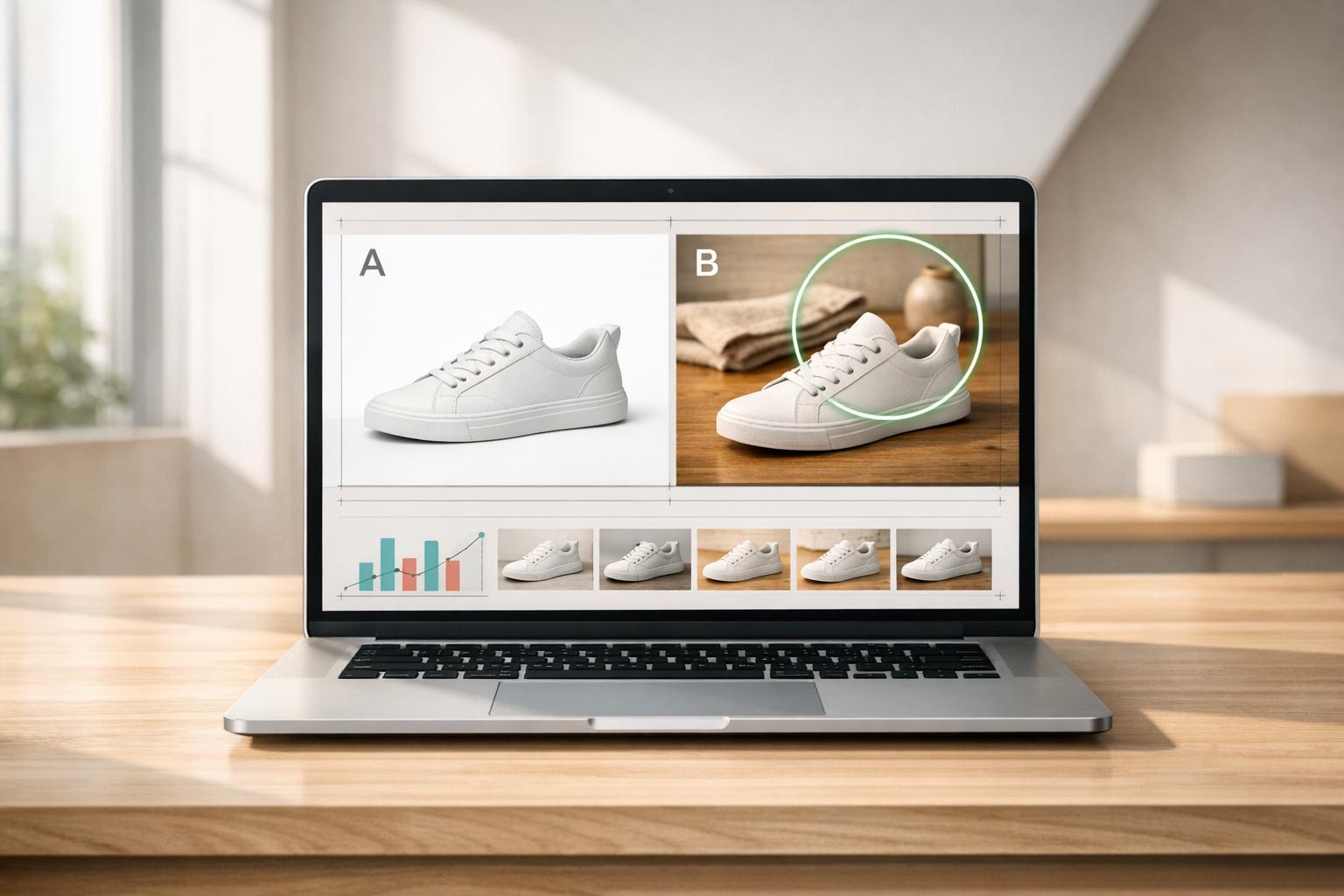
AI has transformed how product images are tested and optimized for e-commerce. Instead of relying on time-intensive methods like manual edits or expensive photoshoots, platforms like PixelPanda use AI to create, test, and analyze image variants quickly and affordably. Here’s what you need to know:
- Speed: AI generates professional-quality images in 15–20 seconds, compared to days or weeks for traditional methods.
- Cost Savings: AI-generated images cost around $0.10 each, versus $25–$150+ for traditional photography.
- Real-Time Insights: AI predicts which image variations will perform best, reducing the need for extended testing periods.
- Customization: Tools like AI Fashion Studio allow for tailored images, such as diverse models or personalized backgrounds.
- Proven Results: Businesses report conversion rate increases of up to 44% and significant reductions in production costs.
AI-powered tools like PixelPanda streamline A/B testing, making it faster, cheaper, and more efficient to optimize product images and boost sales.
I Used AI to Make an Amazon Main Image A/B Test
How AI Improves Product Image A/B Testing
AI has revolutionized the way product image testing is conducted. What once took weeks of manual effort can now be achieved in seconds, with added insights that traditional methods often miss. Let’s dive into how AI reshapes this process.
Automated Image Analysis for Faster Results
AI continuously analyzes product images in real-time, tracking metrics like engagement rates, click-through rates, and visual quality. This automation eliminates the need for manual reviews, delivering concise summaries that simplify reporting for decision-makers.
What makes AI stand out is its ability to uncover hidden patterns within specific user segments. For example, AI can identify performance differences that aggregated data might obscure. Teams leveraging this “opportunity detection” have reported an average 15% improvement in areas traditional methods would have overlooked. Imagine an image that seems underwhelming overall but performs exceptionally with mobile users in a particular region – AI spots these nuances effortlessly.
But AI doesn’t just analyze; it also transforms how images are created.
Quick Variant Generation with AI
Gone are the days of costly photoshoots and time-consuming design work. AI can generate professional-quality product images in 15 to 20 seconds. This allows marketers to create dozens of variations with different backgrounds, lighting, and styles in just 15 minutes.
The cost savings are staggering. While traditional photography can cost between $25 and $150+ per image, AI-generated images cost as little as $0.10 each, slashing expenses by over 99%. A great example comes from January 2026, when Bimago, an online art store, used AI to personalize homepage banners based on visitor behavior and device type. This effort led to a 44% increase in email signups and boosted on-page engagement. By leveraging APIs and batch processing, entire product catalogs can be updated overnight, generating thousands of brand-compliant images at lightning speed.
Real-Time Testing and Performance Prediction
AI doesn’t just speed up analysis and image creation – it also predicts performance outcomes before campaigns even begin. Unlike traditional A/B testing, which requires waiting for results, AI forecasts which image variations are likely to perform best using historical data and visual cues. This allows teams to fine-tune images before launching campaigns.
Additionally, techniques like multi-armed bandits enable AI to direct more traffic to high-performing variants in real time, increasing conversions during testing. Predictive analytics powered by AI accelerates creative insights by 95%, making it a game-changer for marketers.
“In future, there may not be one product. You may have AI that has a hundred variations of the product, and it assembles them dynamically depending on what task you’re doing, so potentially no two people will see the same product.” – Craig Sullivan, CEO, Optimise or Die
Step-by-Step Guide to AI-Powered A/B Testing with PixelPanda
Running A/B tests with PixelPanda is simple. The platform takes care of everything – from creating image variants to tracking performance – so you can focus on boosting conversions.
Step 1: Generate Image Variants with PixelPanda
Start by uploading your product photos directly from your phone or camera. In just 15 to 20 seconds, PixelPanda transforms them into professional-quality images.
Choose styles based on your testing goals. For Amazon listings, use the “Amazon Compliant” option to automatically generate images with pure white backgrounds (RGB 255,255,255) and a 2000x2000px resolution. This ensures your images meet Amazon’s requirement that products fill at least 85% of the frame. For lifestyle images, explore options like Professional, Creative, or Nature packs to showcase your product in relatable settings.
If you’re testing apparel, the AI Fashion Studio is perfect for displaying clothing on AI-generated models. You can customize features like body type, ethnicity, and age to create diverse representations that resonate with your audience. For vehicle images, turn basic lot photos into showroom-ready shots using backgrounds like White Studio, Dark Studio, or Gradient Gray.
You can upload a ZIP file or connect via API to process your entire catalog in one go. PixelPanda’s Image Upscaler also enhances low-resolution images to make them zoom-ready. At approximately $0.10 per image, you can create hundreds of variants without breaking the bank.
Once your image variants are ready, move on to setting up your A/B tests.
Step 2: Set Up A/B Tests on Your E-commerce Platform
Download your newly created images from PixelPanda and upload them to your e-commerce platform. For Shopify, add them as alternate product images. On Amazon, use them to replace your main or secondary images.
Before launching your test, define a clear hypothesis. Identify the variable you want to test (e.g., lifestyle vs. studio images, white vs. gradient backgrounds) and decide which metric to measure – click-through rate, add-to-cart rate, or conversion rate.
Collect baseline data from your current images for at least a week to establish a benchmark. Then, launch your test, making sure to change only one variable at a time. This approach helps you pinpoint exactly what’s driving performance changes.
Step 3: Analyze Results with PixelPanda’s AI Tools
Once your tests are live, PixelPanda’s AI tools make it easy to track and analyze performance. The platform monitors engagement metrics like click-through rates and visual quality. Using historical data and visual cues, the AI predicts performance outcomes, helping you identify winning variants faster than traditional methods. It also highlights opportunities in overlooked sub-segments, with users reporting an average 15% improvement in areas they hadn’t considered.
For campaigns with tight deadlines, such as holiday sales, PixelPanda’s system dynamically shifts traffic to high-performing variants in real time. This approach, known as multi-armed bandit testing, allows you to maximize conversions even while data is still being collected.
Step 4: Apply Winning Variants and Continue Testing
Once you’ve identified the best-performing image, update your product listings immediately. Download the winning variant and replace any underperforming images on your platform.
A/B testing is an ongoing process. Use your current winner as the control and continue experimenting with new ideas. For instance, if a lifestyle image performs well, try testing different room styles or lighting setups. If a white background wins, you might test subtle shadows or gradient effects.
PixelPanda’s credit system keeps testing affordable. Each image costs 1 credit, and any unused credits roll over monthly. The Starter plan at $39/month gives you access to 7,000 images, while the Growth plan at $59/month offers 15,000 images – plenty for testing across your entire product catalog.
sbb-itb-76ad1b7
PixelPanda Features for A/B Testing
PixelPanda takes the A/B testing workflow to the next level, making it faster and more efficient. Trusted by over 10,000 e-commerce brands, the platform provides tools that help you create, test, and refine image variants with ease. These features integrate seamlessly into the A/B testing process, saving time and resources.
AI-Generated Product Photos and Background Removalixelpanda.ai/free-tools/background-remover”>Background Removal
PixelPanda’s one-click background removal tool is a game-changer. It can precisely remove complex backgrounds from product photos, allowing you to replace them with new backgrounds – whether it’s plain white, gradients, or lifestyle settings – in just seconds. This eliminates the need for costly reshoots when testing different styles.
The platform’s API also generates multiple ad banner variants at approximately $0.10 per image, making high-volume testing both affordable and efficient. Simply upload a single product image, and PixelPanda creates a variety of options ready for A/B testing.
With batch processing, entire product catalogs can be updated overnight. This means you can deploy multiple variants across your entire SKU range while gathering performance data – all while you sleep. It’s a huge time-saver that accelerates testing cycles significantly.
upscaling-and-customizable-ai-models” tabindex=”-1″>Image Upscaling and Customizable AI Models
The Image Upscaler ensures your photos meet high-resolution standards, like Amazon’s 2000x2000px recommendation. Considering that over 85% of shoppers prefer high-quality images, this tool directly impacts conversion rates.
PixelPanda also offers customizable AI models that let you tailor images based on criteria like body type, ethnicity, and age. This feature is especially useful for demographic testing. For instance, you can create multiple versions of the same apparel modeled by different AI-generated profiles to see which resonates most with specific customer segments.
One mid-size retailer reported a 23% increase in conversion rates after using these tools, highlighting how standardized, high-quality images can improve A/B testing outcomes.
Virtual Try-Ons and UGC-Style Videos
PixelPanda goes beyond still images with its AI Fashion Studio, which allows for virtual try-ons. This tool showcases how garments look on different body types, helping you test which model demographics appeal most to your audience. The platform can generate unlimited variations quickly, giving you plenty of data to work with.
For video content, PixelPanda offers UGC-style video tools that create natural, lip-synced videos in over 35 languages. These videos cost about $5 each, making it cost-effective to test across various social media platforms.
The results speak for themselves. A Shopify apparel store saw a 42% boost in conversion rates and cut photography costs by 88% using PixelPanda. They reduced image production time to just 5 minutes per product. Similarly, a home decor brand updated its catalog of 850 products with AI-generated lifestyle scenes, leading to a 38% increase in sales volume and saving $68,000 annually. These examples show how PixelPanda’s tools can directly improve A/B testing results and overall business performance.
Measuring the Success of AI-Driven A/B Testing
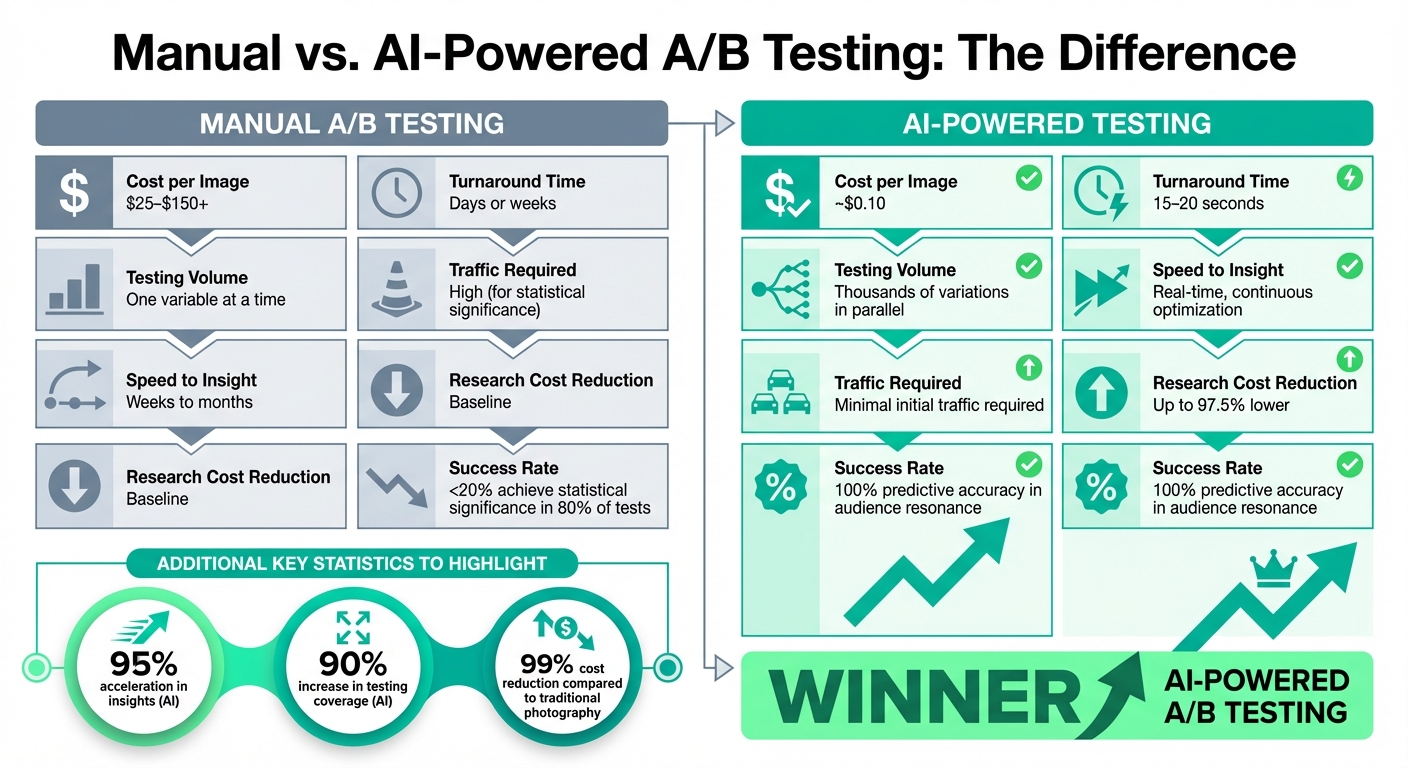
Manual vs AI-Powered Product Image A/B Testing Comparison
Key Metrics to Track
When evaluating the impact of AI-driven A/B testing, it’s crucial to monitor the right metrics. Sales conversion rates provide a direct measure of revenue impact, while click-through rates (CTR) and add-to-cart rates reveal how well images capture attention and drive shopper engagement.
For a deeper understanding, consider metrics like Customer Acquisition Cost (CAC) and Average Order Value (AOV), which help assess long-term profitability. Additionally, keeping an eye on return rates and customer complaints can indicate whether your images are resonating authentically with users.
Tools such as heatmaps offer valuable insights into user behavior by visually mapping where visitors focus on your product pages. Given that the human brain processes images in just 13 milliseconds, even small visual adjustments can lead to noticeable changes in engagement.
These metrics seamlessly integrate with the insights gathered during earlier testing phases, creating a foundation for comparing traditional methods with AI-powered approaches.
Comparison: Manual vs. AI-Powered A/B Testing
The difference in efficiency between traditional and AI-powered testing methods is striking. Take the example of a global snack food company in 2025: they used predictive image analytics to refine their packaging and marketing visuals. The results? 100% predictive accuracy in audience resonance, a 95% acceleration in insights, and a 90% increase in testing coverage – all while slashing research costs by 97.5% compared to traditional methods.
Here’s a side-by-side look at how manual and AI-driven testing stack up:
| Metric | Manual A/B Testing | AI-Powered Testing |
|---|---|---|
| Cost per Image | $25–$150+ | ~$0.10 |
| Turnaround Time | Days or weeks | 15–20 seconds |
| Testing Volume | One variable at a time | Thousands of variations in parallel |
| Speed to Insight | Weeks to months | Real-time, continuous optimization |
| Traffic Required | High (for statistical significance) | Minimal initial traffic required |
| Research Cost Reduction | Baseline | Up to 97.5% lower |
These figures highlight the transformative potential of AI-powered testing. Traditional methods often fall short, with fewer than 20% of marketers achieving statistically significant results in 80% of their manual A/B tests. In contrast, AI predictive analytics can forecast outcomes before campaigns even launch, eliminating the need to wait for live traffic data. This capability enables platforms like PixelPanda to deliver real-time, ongoing optimization.
“AI experimentation isn’t just the future, it’s the edge. Unlike traditional testing methods that are slow, manual, and limited… AI-powered experimentation runs continuously, adapts, and learns.” – Craig Dennis, Hightouch.
Conclusion
AI is revolutionizing product image A/B testing for e-commerce. Gone are the days of waiting weeks or spending thousands on photoshoots. With AI, professional image variants can be generated in minutes, and their performance can even be predicted before launch. Considering that over 85% of shoppers say product photos are the most important factor in their purchasing decisions, speed and accuracy in this area are essential for driving sales and staying competitive.
PixelPanda offers tools like AI-generated photos, background removal, upscaling, and virtual try-ons, making it easier for small businesses and lean teams to create high-quality visuals without the expense of traditional studio setups. These features align perfectly with fast, data-driven testing methods. For example, you can test lifestyle backgrounds versus plain white ones, try out different models or contexts, and pinpoint the most effective variants – all without interrupting live sales or risking your brand’s image.
Brands using AI-enhanced photos have reported up to 25% higher conversion rates and 30% lower bounce rates. Even small tweaks identified through AI testing, such as adding a specific icon or claim, have led to revenue increases as high as 24.56%. These kinds of results help level the playing field, giving smaller businesses a chance to compete with larger retailers.
“AI product photography isn’t about replacing creativity; it’s about scaling it with consistency, precision, and speed.” – Photoroom
Whether you’re managing a handful of SKUs or thousands, PixelPanda can turn time-consuming processes into quick, efficient tasks, making A/B testing a routine part of your strategy. By integrating AI into every step, you can continually refine your visual content and maintain a competitive edge. Now’s the time to embrace AI and transform the way you approach product imagery.
FAQs
How does AI determine which product images will perform best?
AI leverages powerful algorithms to sift through massive datasets, spotting patterns and trends that shape customer behavior. It goes a step further by simulating possible outcomes, helping you predict which product image variations will connect best with your audience – even before you launch them.
This method streamlines the decision-making process, allowing for data-backed choices while ensuring your visuals are crafted to drive higher engagement and boost conversions.
How does AI reduce costs in product image A/B testing?
AI slashes the costs of product image A/B testing by simplifying the creation process. Traditional photoshoots can run anywhere from $200 to $500 per image, while AI-generated images typically cost between $0.10 and $1.00 each – a massive difference in expenses.
On top of that, AI tools can churn out professional, high-quality images in mere minutes. Compare that to the weeks often required for traditional methods, and the time savings become just as impressive as the cost reduction. This speed allows businesses to test ideas and make data-driven decisions much faster and more efficiently.
How do AI-generated product images boost e-commerce sales?
AI-generated product images have the power to elevate e-commerce sales by delivering visually striking, uniform, and professional-grade visuals that connect with shoppers. Quality visuals play a key role in building trust, improving the shopping experience, and presenting products in an appealing way – all of which can lead to increased conversions.
On top of that, AI tools simplify the creation of product photos, cutting down on both time and expenses. This efficiency enables businesses to quickly experiment with and refine their visuals to perform better, ensuring they align with customer preferences and hold their own in a crowded marketplace.