
Let's be honest: "scaling content" used to be a fancy marketing buzzword. Now, it's a matter of survival. The goal isn't just to publish more stuff; it's to build a well-oiled machine that churns out high-quality, on-brand content day in and day out. Think less of a cozy workshop for artisans and more of a humming, efficient factory floor.
You need to shift from tackling one-off projects as they come to building a strategic operation. This means leaning on repeatable workflows, smart automation, and a crystal-clear vision for what you’re trying to achieve.
Why Scaling Content Is No Longer Optional

Feel like you're on a content treadmill that's stuck on high? You’re not alone. The friendly neighborhood marathon has turned into a full-blown arms race, and the finish line is a moving target. If you’re still clinging to manual, one-off creation methods, you're on the fast track to burnout and watching your competitors lap you.
This isn't about simply "keeping up." The demand for fresh, engaging content has absolutely exploded, fueled by a few powerful forces that are probably making your daily grind a lot more… grind-y.
The Forces Driving the Content Arms Race
The global content marketing industry is on a rocket ship, soaring from USD 36.8 billion in 2018 to a projected USD 600 billion by 2024. That's not just growth; it's an explosion.
This cash infusion means your competitors are likely upping their game. In fact, a whopping 54% of businesses cranked up their content budgets in 2024, dumping a ton of that money into video and SEO. You can dig into some fascinating content marketing statistics to see just how wild things are getting.
On top of that, the creator economy has completely rewired audience expectations. People are now used to a 24/7 firehose of slick, personalized content from their favorite influencers and creators. This puts immense pressure on brands to deliver that same constant, high-touch experience—a feat that's next to impossible without a system built for scale.
The real bottleneck isn't a lack of good ideas or talented people. It's operational friction. Manual, repetitive processes are the single biggest thing holding teams back from meeting modern content demands.
What This Means For Your Team
This new reality is putting a massive strain on creative and development teams. The old "one-person-does-it-all" model is completely shattered. Trying to make one person write, design, edit, code, and publish is a recipe for disaster.
It leads directly to:
- Wobbly Quality: When people are rushed, brand guidelines go out the window, visuals get sloppy, and the final product just feels… off.
- Creative Burnout: Forcing your best minds to do mind-numbing, repetitive tasks is the fastest way to kill their strategic and innovative spark.
- Lost Ground: While your team is bogged down manually resizing a dozen social media images, your competition is already launching their next big campaign.
The only way out of this cycle is to learn how to scale content creation properly. It's about engineering a system that runs on smart strategy and automation, not just sheer willpower and late nights. This guide is your playbook.
To put it all in perspective, here's a quick look at the pressures and the path forward.
The Content Scaling Imperative At a Glance
| Growth Driver | The Challenge for Your Team | The Solution |
|---|---|---|
| Massive Market Growth | Competitors are outspending and out-producing you, making it harder to get noticed. | Develop repeatable workflows to increase output without sacrificing quality. |
| New Audience Expectations | Your audience demands a constant stream of high-quality, personalized content on every channel. | Build a structured team with clear roles to handle specialized tasks efficiently. |
| The Rise of Visuals & Video | Creating compelling visuals is time-consuming and often requires specialized, expensive skills. | Automate repetitive tasks (like image processing) and templatize designs to move faster. |
| Need for Multi-Channel Presence | You have to be everywhere at once, but each platform has unique format requirements. | Create a central content "engine" that can efficiently repurpose core assets for different channels. |
Ultimately, the teams that build a true content engine will be the ones who win. The ones who don't? They'll be left in the dust.
Laying the Foundation: Your Content Scalability Blueprint
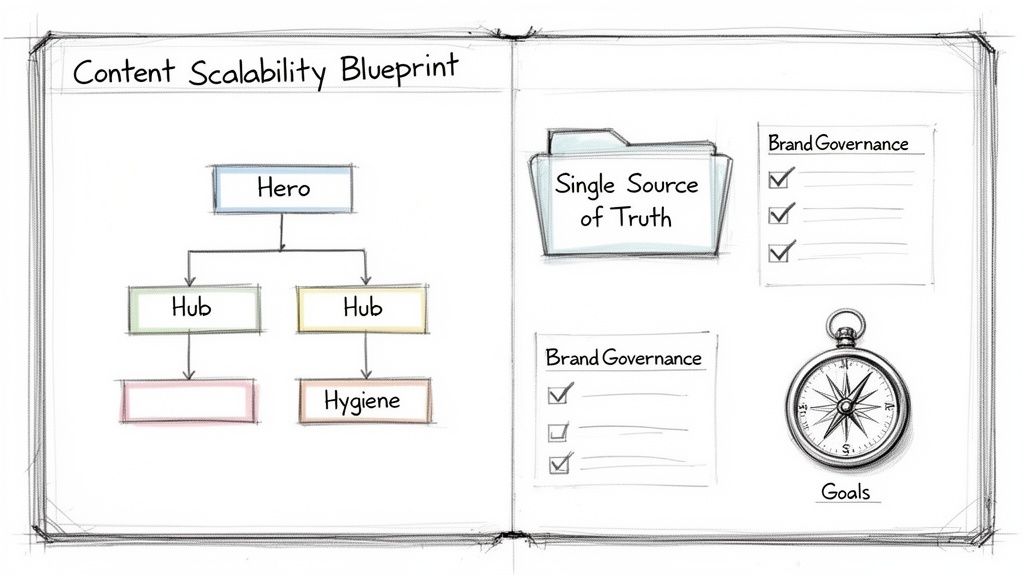
Let's get one thing straight: scaling content isn't about just hiring more writers or smashing the "publish" button twice as often. That’s how you get a content farm, not a content engine. It's a one-way ticket to chaos, burnout, and a mess of off-brand blog posts.
Real scale comes from a smart, deliberate blueprint. It’s about shifting your team from a reactive "fire drill" mode to a proactive, well-oiled machine. Think of it like an architect designing a skyscraper—you need plans, rules, and a clear vision before you even think about laying the first brick.
This is your architectural plan.
First Things First: Define Your North Star
Before you write a single headline, you have to answer the most important question: Why? Vague goals like "get more traffic" are useless. Your content objectives need to be welded directly to real business outcomes.
What's the actual mission? Are you trying to:
- Generate qualified leads? Then your content needs to be a problem-solving machine for your ideal customer, gently guiding them toward your solution.
- Boost brand awareness? This calls for big, top-of-funnel ideas and shareable content that introduces your brand’s personality to the world.
- Drive product adoption? In this case, your content becomes an educational tool, showing off features and best practices to make your current users successful.
Nailing these goals acts as a powerful filter. Every new idea gets held up against it. If that cool new video series doesn't directly serve your primary mission, it gets shelved. This kind of ruthless focus is the first real step in learning how to scale content creation without losing your mind.
A content strategy without a clear business goal is just a hobby. Every article, video, and social post needs a job to do. If it doesn't, it's just noise.
Create Your Single Source of Truth
The moment you add a second creator to the mix—whether it's an in-house hire, a freelancer, or an agency—you introduce risk. Without a central rulebook, your brand voice starts to wobble, your visuals get messy, and your core message gets watered down.
This is where governance saves the day. You need a "single source of truth," a living, breathing document that defines everything about your content.
Make sure it covers the non-negotiables:
- Brand Voice and Tone: Are you quirky and fun? Authoritative and serious? Give concrete examples of what to do and, more importantly, what not to do.
- Style Guide: End the silly debates before they even start. Do you use the Oxford comma? Title Case for headlines? Get it all written down.
- Visual Guidelines: Lock in your color palettes, logo usage, typography, and the specific vibe of your imagery. This is essential for building a recognizable brand.
This document isn't a friendly suggestion; it's the law. It’s what ensures a blog post written by a freelancer in another time zone feels exactly like it came from your core team.
Adopt the Hero, Hub, Hygiene Model
Not all content is created equal, and you'll burn through your budget and team morale if you try to treat it that way. You can't give a simple FAQ blog post the same blockbuster treatment as your annual industry report.
A much smarter way to work is to categorize your content into a strategic hierarchy. The Hero, Hub, Hygiene model is a brilliant framework for this.
- Hero Content: These are your massive, tentpole campaigns. Think of a huge product launch, a data-rich annual report, or a high-production-value video series. They are high-effort, infrequent, and designed to make a huge splash.
- Hub Content: This is your regularly scheduled programming for your core audience. It's the stuff that keeps them coming back. We're talking about a weekly webinar, a monthly deep-dive newsletter, or a podcast. It's all about consistency and community building.
- Hygiene (or Help) Content: This is your "always-on" foundation. It’s the practical, helpful content that answers the specific questions your audience is typing into Google. Think "how-to" guides, tutorials, and ultimate guides. This is the bedrock of your SEO strategy.
This model provides an immediate roadmap for your resources. You know a simple "hygiene" post doesn't need a ten-person review cycle, which frees up your team to focus on the big "hero" moments. At its core, scaling any operation is about figuring out how to automate business processes so you can focus on high-impact work. This model helps you do just that.
The explosion in the social media content creation market—from USD 10.04 billion in 2026 to a projected USD 19.18 billion by 2030—is proof of this demand. That staggering 17.5% annual growth rate shows that businesses that can't scale their visual production will be left behind. This isn't a "nice to have" anymore; it's a critical business function.
Assembling Your Content Dream Team
Let's be honest. When things get busy, the knee-jerk reaction is to just "hire more writers." I've seen it a dozen times. But that’s like trying to build a Formula 1 car by just buying more tires—you're missing the chassis, the engine, and the person who actually knows how to drive the beast.
To truly scale, you have to stop thinking in terms of generic "Content Creator" roles and start building a specialized team. In a high-volume operation, you don't need a jack-of-all-trades; you need a crew of experts, each owning a critical piece of the production puzzle.
The Key Roles in a Modern Content Machine
Forget the old-school, siloed marketing department. A modern content team runs more like a product team—agile, collaborative, and laser-focused on a shared goal.
Here are the specialists who will form the backbone of your operation:
- Content Strategist: This is your captain, your big-picture thinker. They aren't just brainstorming blog topics. They're mapping content to every stage of the buyer's journey, diving deep into keyword research, and ensuring every single piece of content serves a real business objective. They answer the "why" behind everything you create.
- SEO Analyst: Your data wizard. This person lives and breathes analytics, search console, and tools like Ahrefs or Semrush. They hunt for content gaps, obsessively track keyword performance, and deliver the hard data that turns good content into content that actually ranks and brings in leads.
- Content Operations Manager: This is the unsung hero, the master of process. This role is your secret weapon for scaling smoothly. They build the workflows, manage the content calendar, wrangle the tools, and obliterate bottlenecks before they become a problem. They’re the ones who make sure the content factory is a well-oiled machine.
- Writers & Subject Matter Experts (SMEs): The storytellers and the brains. You need a mix of versatile writers who can nail your brand voice and deep SMEs who bring the credibility and firsthand expertise your audience is starving for.
- Visual Content Specialist: In a world scrolling through an endless feed, this role is non-negotiable. They create everything from custom illustrations and slick infographics to video clips and shareable social media graphics. They make sure your content looks as good as it reads. You can even explore ways to generate high-quality user-generated content to supplement your in-house efforts.
The goal isn't just to hire people to fill seats. It's to build a system of interlocking skills where each person's expertise amplifies the others. The strategist provides the vision, the analyst brings the data, the writer crafts the story, and the ops manager makes it all happen on time, every time.
Structuring Your Team for Maximum Impact
Hiring the right people is only half the battle. How you organize them is just as crucial. I've seen three models work well in different situations.
- Centralized Model: One dedicated content team serves the entire company. This setup is fantastic for maintaining rock-solid brand consistency and operational efficiency.
- Decentralized Model: Content creators are embedded directly within different business units (e.g., a writer for product marketing, another for the sales team). This guarantees deep subject matter expertise but can sometimes lead to a fragmented brand voice if you're not careful.
- Hybrid Model (Center of Excellence): This is often the sweet spot for growing companies. A central team sets the grand strategy, governance, and best practices, while creators embedded in other departments can execute within that established framework.
The right model really depends on your company's size and complexity. A scrappy startup will probably thrive with a centralized team, while a global enterprise might need a hybrid approach to stay nimble.
The Eternal Debate: In-House vs. Freelancers
Finally, the million-dollar question: who do you actually hire? Do you build a full-time, in-house army or tap into a flexible network of freelancers?
My experience? The answer is almost always a strategic mix of both.
- Hire In-House For: Your core, strategic roles. Your Content Strategist and Operations Manager should be in-house, living and breathing your brand's vision and its processes.
- Leverage Freelancers For: Specialized or high-volume production. Need a brilliant expert to write a deeply technical whitepaper? Hire a freelance SME. Need to churn out 20 high-quality blog posts this month to hit your goals? A team of vetted freelance writers is your best bet.
This flexible approach lets you crank your output up or down without the heavy overhead of a massive full-time payroll. It’s all about building a nimble team that can adapt to explosive market trends.
For instance, the influencer marketing space is projected to be a USD 33 billion market by 2025, with a mind-boggling 171% budget expansion planned for that year alone. This massive boom in creator-led content demands a team structure that can handle sudden, high-volume workflows without breaking a sweat. If you want to dive deeper, you can check out the latest influencer marketing trends from CreatorIQ.
Designing Repeatable Workflows and Templates
A great content engine isn’t built on the back of a few heroic all-nighters. It’s built on a rock-solid, repeatable system. Seriously.
Think of it like a professional kitchen. The world-class chef isn't peeling every single potato or dicing every onion. There's a well-oiled process—the mise en place—where everything is prepped, standardized, and ready to roll. This frees up the chef to focus on the magic, not the mundane.
That’s exactly what repeatable workflows and templates do for your content team. They create constraints that, weirdly enough, unlock creativity and speed. By building a documented "assembly line" for every type of content you produce, you eliminate the soul-crushing guesswork and administrative drag that absolutely kills momentum.
Instead of your team constantly asking, "Okay, what do I do next?" they can pour that energy into what actually matters: creating exceptional work. A well-oiled workflow is the single most impactful thing you can do to scale up without burning out.
This flowchart breaks down the core roles that keep a scalable content process moving, from high-level strategy all the way to getting it published.
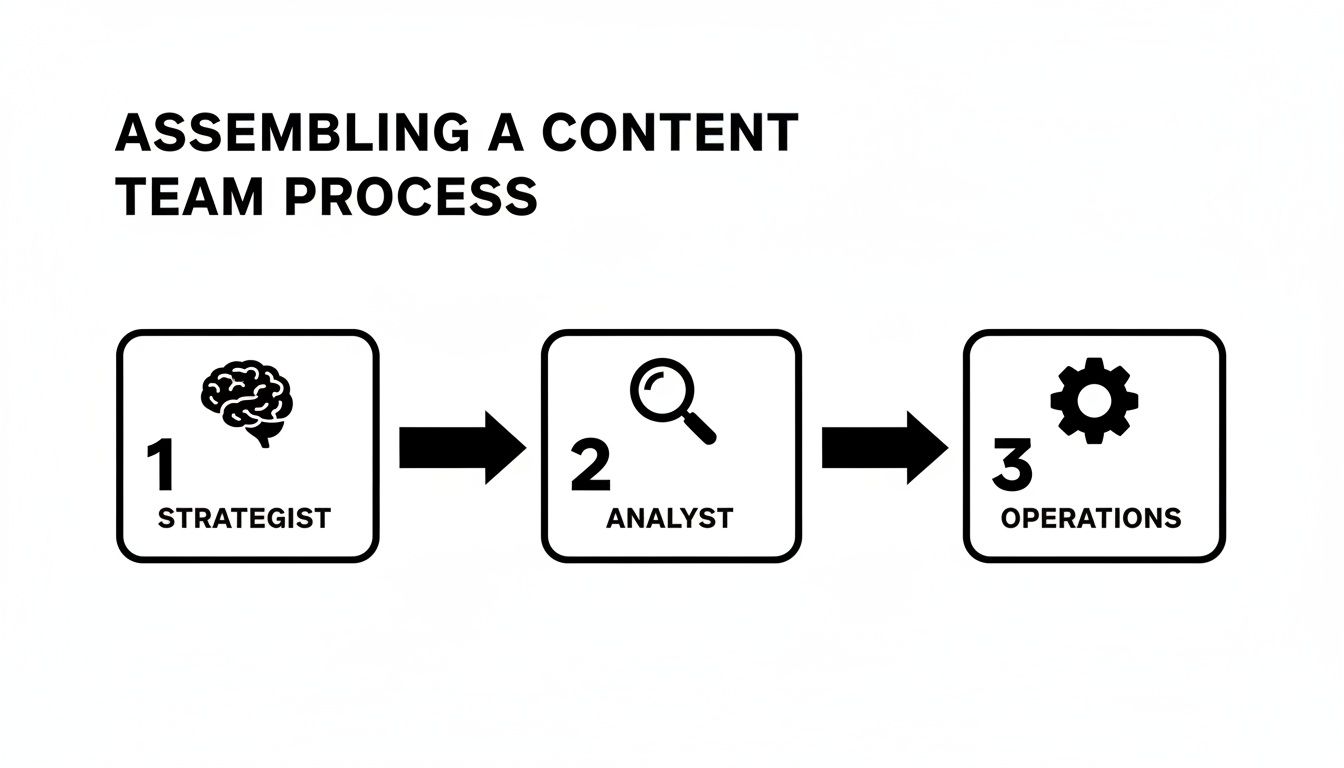
You can see how the strategist sets the vision, the analyst brings in the data to point everyone in the right direction, and the ops manager makes sure the whole machine runs smoothly.
Building Your Content Brief Template
The content brief is the absolute cornerstone of your entire workflow. Get this wrong, and you’re signing up for a world of pain. A weak, ambiguous brief is a one-way ticket to endless revision cycles, missed deadlines, and content that completely misses the mark.
Your goal should be to create a standardized template so bulletproof that a freelancer you’ve never even spoken to can nail the assignment on the first try. This master brief becomes the single source of truth for any given content piece.
A non-negotiable brief must include:
- The Primary Goal: What is the one thing this piece needs to achieve? (e.g., "Generate demo requests for our new X feature.")
- Target Audience: Who are we really talking to? Get specific about their pain points. (e.g., "Marketing managers at B2B SaaS companies struggling with lead attribution.")
- Core Angle & Key Takeaways: What’s our unique perspective? What three things must the reader walk away knowing?
- Target Keywords: List the primary and secondary keywords, along with the search intent behind them.
- Internal Linking Map: Spell out exactly which existing pages this new article must link to.
- Competitor Teardown: Link to the top 3-5 ranking articles and add a sentence or two on their weaknesses (and how we'll be better).
This level of detail feels like a lot of up-front work, but it saves you from chaos later. It vaporizes ambiguity and empowers creators to work with confidence and autonomy.
A great brief doesn't just tell a writer what to write; it tells them why it matters and who it's for. It aligns the entire team—from writer to designer to SEO analyst—around a single, clear objective from the very beginning.
Creating Modular Content Templates
The next layer of your assembly line is building out modular templates for your most common content formats. This isn't about creating fill-in-the-blank Mad Libs that churn out robotic, soulless content. It’s about standardizing the structure so your creative team can focus on the substance.
An incredibly effective way to scale is by implementing smart content repurposing strategies, which lets you squeeze every last drop of value from your existing work. Templates make this a thousand times easier.
For example, a "How-To Guide" template might have these pre-defined sections:
- The Hook: Start by hitting on the reader’s problem and promising a clear solution.
- The Checklist: A quick list of any prerequisites or tools they’ll need.
- The Step-by-Step: Use clean, clear subheadings for each action.
- The "Watch Out For This": A section to address common mistakes and pitfalls.
- The Wrap-Up & CTA: A quick summary of the outcome and a clear next step.
You can do the same for case studies, listicles, product updates—you name it. In our own work, we've found that a solid template library can slash drafting time by as much as 40%. You can see how we apply these very principles in our own operation at the PixelPanda Content Studio.
By systemizing the skeleton of each piece, you let your team spend their precious brainpower on the heart—the compelling stories, unique insights, and valuable information that will actually connect with your audience. This methodical approach is the real secret to producing great content at high velocity.
Automating Production With Smart Tools
Alright, this is where the real magic kicks in. A solid strategy and a killer team get you to the starting line, but smart automation is what lets you run the marathon at a sprinter’s pace.
The goal isn't to replace your creative team with robots. It’s to eliminate the soul-crushing, repetitive tasks that drain their energy and slow everything down. By building a thoughtful tech stack, you free up your people to focus on what they do best: being creative and strategic. This is the absolute core of how to scale content creation without burning everyone out.
Your Foundational Tech Stack
Before you get distracted by all the shiny new toys, you need to nail down the basics. Without a central hub to manage your workflow, even the best automation tools will just create more chaos.
Think of these as your non-negotiables:
- Project Management Powerhouse: You need a single source of truth. Tools like Asana, Trello, or Monday.com are your command center. They give you total visibility into your content pipeline, so you always know who’s doing what and when it’s due.
- SEO Intelligence Tools: You can't scale what you can't measure. Platforms like Ahrefs or Semrush are essential for digging up content opportunities and tracking performance. They ensure you're creating stuff people are actually searching for.
- AI Writing Assistants: The blank page is a notorious productivity killer. AI assistants like Jasper or Copy.ai can be incredible partners for busting through writer's block or spinning up a first draft. Just remember, they’re a starting point, not a replacement for a skilled writer's voice.
The best tech stacks aren't about having the most tools. They're about having the right tools that talk to each other, creating a smooth workflow that just… works.
The Biggest Bottleneck: Visual Content Automation
Let's be brutally honest for a second. Manual image editing is one of the biggest time-sucks in any content operation. It's tedious, it requires specialized skills, and it's a nightmare to scale.
Imagine your team has to manually remove the background from 500 product photos for a new e-commerce launch. That’s hundreds of hours of mind-numbing work that could be spent on actual strategy. This is where visual automation tools, especially image-processing APIs, become an absolute game-changer. They handle all that grunt work programmatically, letting you achieve in minutes what would take a designer days to complete.
Think about what suddenly becomes possible:
- E-commerce Catalogs: Automatically generate thousands of clean, professional product cutouts with perfect, transparent backgrounds. No more hand-tracing with the pen tool.
- Social Media Campaigns: Programmatically create hundreds of on-brand social media banners by layering text and logos onto approved background images.
- User-Generated Content: Instantly upscale and enhance lower-quality user photos so they meet your brand’s quality standards.
For teams drowning in visual requests, figuring out how you can create UGC without relying on creators through automation is a massive unlock.
This screenshot shows how a developer-friendly platform like PixelPanda puts a whole suite of image processing tools right at your fingertips through a simple API.
What’s so powerful here is the sheer range of capabilities—from background removalixelpanda.ai/free-tools/background-remover”>background removal to upscaling—all designed to plug directly into your existing workflows. You're automating visual production right at the source.
Building a Content CI/CD Pipeline
For more advanced teams, especially those with some dev resources, the holy grail is a Content CI/CD (Continuous Integration/Continuous Deployment) pipeline. This is a concept we've borrowed from the software development world, and it automates the entire journey from draft to publication.
Picture this: a writer finishes a blog post in a headless CMS and hits "save." A fully automated pipeline instantly kicks in.
- Text is Processed: The content is automatically checked for grammar, style guide compliance, and SEO optimization.
- Visuals are Generated: The featured image is sent to an API like PixelPanda, which automatically resizes it for the blog, a social media card, and an email newsletter banner.
- Content is Published: The finished post and all its new visual assets are pushed live to your website and distributed across your social channels.
This isn't some futuristic dream; it's what the most efficient content teams are building today. It transforms publishing from a clunky, multi-step manual process into a single, automated action. It's the pinnacle of a truly scalable content engine.
Measuring What Matters to Fuel Growth
Look, scaling your content without a solid measurement plan is like throwing a massive, expensive party and never asking if anyone had fun. You're putting in all this effort, but you have no clue if it's actually working. It’s time to stop chasing vanity metrics and start tracking what truly moves the needle.
Page views and social shares are nice for the ego, but they don't pay the bills. The real magic happens when you build a feedback loop that ties every single piece of content to a real business outcome. This is how you stop guessing and start knowing, turning your content engine from a budget line item into a predictable growth machine.
Moving Beyond Vanity Metrics
First thing's first: you need to redefine what "success" even means. Forget obsessing over traffic spikes. Instead, focus on the numbers that signal genuine customer action and have a real impact on your bottom line. This means getting surgical with your analytics and tracking the entire customer journey, not just the first click.
Start by zeroing in on these performance indicators:
- Conversion Rate: Of all the people who read a post, what percentage actually takes the next step? This could be anything from a newsletter signup to a demo request.
- Lead Quality: Are the leads coming from your content actually a good fit for your sales team? Tracking this stops you from building a massive machine that just generates noise and headaches for sales.
- Pipeline Influence: How many deals sitting in your CRM were touched by a specific blog post or guide? This is how you draw a direct line from your words to your revenue.
- Customer Lifetime Value (CLV): Do the customers who engage with your content stick around longer and spend more? This proves your content isn't just acquiring customers, but better ones.
Scaling content successfully isn't about producing more; it's about producing more of what works. And data is the only reliable way to figure out what "works" actually means for your business.
Building Your Content Performance Dashboard
Once you know what you’re tracking, you need a command center to see it all. A content performance dashboard is your mission control. It doesn't have to be some overly complicated beast—a tool like Google Data Studio or a more specialized analytics platform can pull everything into one place.
Your dashboard should give you an at-a-glance view of your most critical KPIs. For instance, you could set up a simple table that tracks each new article's performance against your key metrics over its first 30 days. This immediately establishes a baseline and makes your star performers jump right off the page.
Having this data on hand isn’t just for reporting up; it fosters a culture of constant improvement. You can start running regular content audits, fueled by this dashboard, that show you what topics are hitting home, which formats convert best, and where you need to double down. Every insight sharpens your strategy, making your content engine smarter and more lethal with every publishing cycle.
Got Questions About Going Big With Content?
So, you're thinking about cranking up the content dial. It's a smart move, but it's also totally normal to feel a little nervous. Will quality take a nosedive? Is this going to be a massive headache to set up? Let's get into the nitty-gritty and tackle those common "what ifs" right now.
How Do You Go Big Without Sacrificing Quality?
Here’s the secret: you build a rock-solid system for everything except the creative magic. You can't put "brilliant idea generation" into a Trello card, but you can build an ironclad process that lets those ideas shine.
This means getting serious about brand guidelines, creating killer templates for every content type, and building a review process with multiple checkpoints. Quality control stops being a last-minute panic-check and becomes a deliberate, baked-in part of the workflow. The machines handle the grunt work, which frees up your brilliant humans to focus on what they do best: telling incredible stories.
Scaling content isn't about working faster, it's about working smarter by eliminating friction. A great system doesn't stifle creativity; it protects it by making the right way the easiest way to get things done.
Okay, So What’s the Very First Step?
Before you hit the accelerator, you need to know where the heck you are. Kick things off with a content audit. I mean a real one. Map out every single step your team takes, from that first spark of an idea to the moment you hit "publish."
Now, hunt for the bottlenecks. Where does everything grind to a halt? Is it the endless review cycles? The constant back-and-forth on visuals? A vague brief that sends everyone down a rabbit hole?
Find your single biggest pain point and attack that first. Don't try to boil the ocean. Often, the biggest win comes from creating a standardized content brief or a central content calendar. Nail one small, repeatable fix and then build on that momentum.
What Tools Are Actually Mission-Critical?
Your tech stack is the engine of this whole operation. While the exact tools will vary, every successful high-volume content machine I've seen has a few key components:
- A Solid Project Manager: You need a single source of truth. Whether it's Asana, Trello, or Monday.com, a good PM tool keeps the chaos organized and gives everyone visibility.
- A User-Friendly CMS: If your team needs to file a ticket with a developer just to post a blog, you’ve already lost. Your Content Management System needs to be intuitive and flexible.
- Pro-Level SEO Tools: You can't guess your way to the top of Google. Platforms like Ahrefs or Semrush are non-negotiable for smart research and optimization.
- Visual Automation APIs: Let’s be honest, manually creating and resizing images is a soul-crushing time-sink. This is where an image-processing API becomes your best friend, automating everything from background removal to banner generation at scale.
Ready to kill your biggest visual bottleneck for good? With PixelPanda, you can automate everything from product cutouts to social media banners with a simple API call. Start your free trial and see how easy it is to scale your visual content today.