
AI is transforming fashion photography by making it faster, cheaper, and more efficient. Tools like PixelPanda AI Fashion Studio are replacing traditional photoshoots with automated solutions that create high-quality images in seconds. By 2026, the AI-generated fashion photography market is expected to grow significantly, driven by two main technologies: automated post-processing and virtual try-on. Here’s what you need to know:
- Cost Savings: AI cuts production costs by 70–90%. PixelPanda, for example, charges just $0.10 per image compared to $25–$150+ for traditional methods.
- Time Efficiency: AI reduces production timelines from weeks to seconds, enabling brands to quickly respond to trends.
- Customization: AI tools allow brands to create diverse model representations and simulate fabrics with high accuracy.
- Business Impact: AI-driven photography boosts sales by 5–15% and reduces product returns by up to 40%.
While AI excels in speed and scalability, traditional photography still offers unmatched artistic quality, making it ideal for luxury and high-value campaigns. Many brands now combine both approaches to balance efficiency with visual depth.
1. PixelPanda AI Fashion Studio

Efficiency and Time Savings
Traditional fashion photography is notoriously time-consuming, often requiring weeks to coordinate models, samples, and post-production. PixelPanda completely transforms this process, reducing the production cycle to under 15 seconds. By automating the "product-to-model" transformation through artificial intelligence image editing, a simple flat-lay photo is instantly turned into a professional model shot. This automation results in a 95% faster turnaround compared to conventional methods.
Virtual shoots also eliminate many logistical headaches like physical samples, location scouting, and large crews. This allows brands to adjust quickly to market trends and keep up with fast-paced seasonal launches or flash sales. For e-commerce teams juggling hundreds of SKUs, this kind of speed can make all the difference.
Cost Effectiveness
PixelPanda doesn’t just save time – it slashes costs too, offering 90% lower expenses. For brands with extensive catalogs, this can mean saving tens of thousands of dollars each season.
Their pricing is designed to scale with business needs. The Starter plan is priced at $39 per month for 7,000 images, while the Pro plan supports 35,000 images for $89 per month. To put this in perspective, most entry-level AI tools charge $8–$19 per month for just 50–100 images. Additionally, brands using AI-powered photography have reported an average ROI increase of 340%.
Image Quality and Customization
Cost savings aside, the quality of visuals is critical for reducing returns and building a strong brand identity. PixelPanda’s AI Fashion Studio delivers remarkable results, with over 90% accuracy in rendering fabric drape, texture, fit, and color. It ensures consistent pattern scale and color integrity, even in varying lighting conditions – an essential feature for minimizing product returns.
The platform also offers advanced tools like AI Restyle and Material Fusion, which allow designers to simulate fabrics such as leather, silk, or denim with realistic physics – all through simple text commands.
Customization is another standout feature. Brands can create AI models that showcase diverse body types and ethnicities, enabling hyper-personalized content for different markets and consumer demographics.
Scalability for E-Commerce
PixelPanda’s scalability makes it a perfect fit for the ever-changing demands of e-commerce. Seamless integration with PIM and DAM tools allows teams to process entire product catalogs overnight. This capability has led to 30% higher conversion rates and 20–30% fewer product returns for brands using AI-powered fashion photography.
With the ability to generate high-quality images in under 60 seconds, e-commerce teams can dramatically increase content production without adding extra staff. For growing brands operating across multiple channels, this is a game-changer.
sbb-itb-76ad1b7
2. Traditional Post-Processing Methods
Efficiency and Time Savings
Compared to AI-driven workflows, traditional post-processing methods often reveal significant limitations in both time and cost. Fashion photography using these methods follows a linear and time-intensive process. After the photoshoot, retouchers meticulously adjust details using tools like Adobe Photoshop‘s healing brush, a process that can take one to two weeks. From start to finish, the entire production timeline typically stretches over 2–4 weeks.
Making changes after the shoot is another challenge. It often requires either restarting the production cycle or engaging in labor-intensive manual editing. This rigidity can lead to complications, especially when market trends shift quickly or when late feedback demands rapid adjustments.
Cost Effectiveness
The financial demands of traditional methods can quickly escalate. Post-production editing alone costs between $1,000 and $3,000 per shoot, while photographer fees drive the per-image cost to an average of $75–$250. When factoring in photographer day rates ($1,000–$5,000) and full session expenses ($15,000–$50,000), the overall costs become steep. These expenses grow even more prohibitive as the number of products increases, making it difficult for traditional methods to adapt to fast-changing market demands.
Image Quality and Customization
Traditional photography has long been celebrated for its ability to capture intricate details and artistic nuances. Photographers use techniques like precise lighting adjustments, focus manipulation, and long exposure to highlight fabric textures and create visually striking compositions. Manual retouching further enhances this artistry, allowing for exact adjustments to skin textures, patterns, and other fine details.
As Kalpesh Lathigra, MA Commercial Photography Lead at the London College of Communication, notes:
"A machine can give you millions of possibilities, but it can’t give you that elusive, intangible thing that draws us in and holds us, which has remained the same since the dawn of photography."
This human touch is particularly valued by luxury brands, which rely on it to preserve their identity and build emotional connections with customers. Traditional methods also shine when working with complex materials like metallics, sequins, or unique textures, which are often rendered more faithfully than by automated systems. Moreover, spontaneous expressions and the emotional depth captured by human photographers remain difficult for algorithms to replicate.
Scalability for E-Commerce
When it comes to scaling for e-commerce, traditional workflows face significant challenges. The 2–4 week turnaround time often clashes with the fast-paced demands of inventory turnover. This delay can disrupt product launches and seasonal campaigns, creating inefficiencies that ripple through the supply chain. Additionally, inconsistencies in visual output can arise when different photographers, lighting setups, or styling approaches are used across large catalogs.
These delays and inconsistencies contribute to higher apparel return rates, as static images often fail to accurately depict fit and texture. To adapt, some professional retouchers are repositioning themselves as "AI consultants", while brands are increasingly adopting hybrid strategies. Many now reserve traditional photography for high-value collections or premium branding efforts, blending it with newer technologies to balance quality and scalability.
Pros and Cons
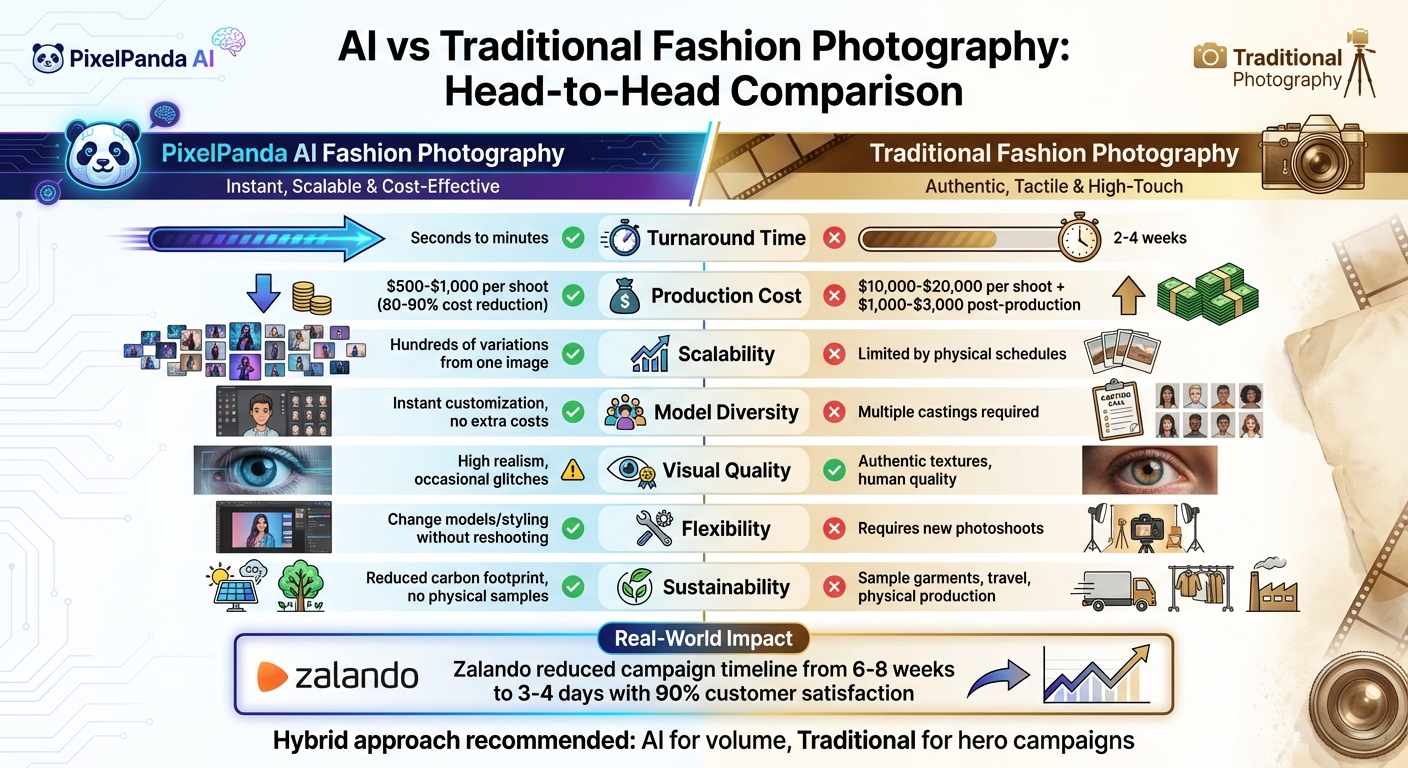
AI vs Traditional Fashion Photography: Cost, Time and Performance Comparison 2026
This section breaks down the practical trade-offs between best AI tools for photo editing and traditional methods in post-production. The decision often revolves around speed, cost, and creative control, with each approach offering distinct advantages depending on a brand’s needs and scale.
| Feature | PixelPanda AI Fashion Studio | Traditional Post-Processing |
|---|---|---|
| Turnaround Time | Seconds to minutes for professional model shots | 2–4 weeks from shoot to final images |
| Production Cost | $500–$1,000 per shoot, cutting costs by 80–90% | $10,000–$20,000 per shoot, plus $1,000–$3,000 for post-production |
| Scalability | Generates hundreds of variations – models, poses, backgrounds – from one image | Limited by physical shoot schedules and labor hours |
| Model Diversity | Instantly customizes model attributes without extra casting costs | Requires multiple castings and potential reshoots |
| Visual Quality | Delivers high realism, though occasional glitches occur | Captures authentic fabric textures and the subtle "human quality" |
| Flexibility | Allows model or styling changes on existing assets without reshooting | Requires entirely new photoshoots for styling updates |
| Sustainability | Reduces carbon footprint by eliminating physical samples and travel | Relies on sample garments, location travel, and physical production |
This comparison highlights the balance between speed and scalability with AI tools versus the artistic depth of traditional methods.
AI-powered production excels in efficiency and volume. For instance, Zalando shortened its campaign timeline from 6–8 weeks to just 3–4 days, with 90% of shoppers expressing satisfaction with AI-based size recommendations. Meanwhile, traditional methods maintain their edge in delivering nuanced artistic quality and texture detail.
Despite the data-driven advantages of AI, some experts still value the human element. Photographer Charlie Engman, who integrates AI into his work, explains:
"Historically, retouchers were not seen as a particularly creative part of the process… [now they are] AI consultants".
This evolving landscape suggests both approaches have their place, depending on the project’s priorities.
Conclusion
When deciding between AI tools and traditional photography, the best choice depends on your specific business goals and what you value most: speed and cost-efficiency or creative depth and authenticity.
For e-commerce, AI tools like PixelPanda AI Fashion Studio excel at streamlining production. They can cut costs by up to 90% and reduce timelines from weeks to just minutes, making studio-quality imagery accessible even for smaller brands. This makes AI an appealing option for businesses focused on efficiency and scalability.
However, efficiency alone doesn’t tell the whole story. For campaigns that rely on emotional resonance, natural light, or collaborations with influencers, traditional photography still shines. As Kalpesh Lathigra points out, traditional methods bring a level of authenticity and artistic depth that AI struggles to achieve.
Many brands now combine both approaches to maximize their potential. For instance, they might use traditional photography for hero looks that define their visual identity, while leveraging AI to create variations like alternate colorways, model swaps, or social media content. This hybrid strategy allows brands to maintain their creative integrity while scaling operations affordably.
Ultimately, the choice comes down to your priorities: AI for efficiency and volume, or traditional methods for storytelling and artistry. By 2026, finding the right balance between the two will be key to achieving the best results.
FAQs
How is AI transforming the cost and efficiency of fashion photography?
AI is transforming the fashion photography scene, making the process quicker, less expensive, and incredibly efficient. With tools like virtual photoshoots, automated editing, and AI-generated visuals, brands can now cut back on traditional expenses – think large crews and pricey equipment – while still delivering top-tier quality.
What’s more, AI-powered tools simplify post-production and speed up content creation, enabling brands to roll out campaigns faster than ever. Beyond saving time, this tech introduces exciting features like virtual try-ons, enriching both the creative workflow and the shopping experience for customers.
What are the benefits of using AI tools like PixelPanda for e-commerce brands?
AI tools like PixelPanda are changing the game for e-commerce brands by making professional-quality product photography more accessible and cost-effective. Traditionally, creating product images could set businesses back hundreds of dollars per photo. With AI, however, brands can produce stunning visuals for as little as $0.10 per image. This eliminates the need for costly studio setups or hiring professional photographers, making high-quality imagery achievable for businesses of all sizes.
Beyond affordability, these tools save a significant amount of time. Take PixelPanda, for instance – it can process up to 100 images simultaneously, slashing production timelines. Features like automatic background removalixelpanda.ai/free-tools/background-remover”>background removal and image upscalinghttps://pixelpanda.ai/free-tools/enhance-photo”>upscaling ensure that every photo meets marketplace standards, looking clean and polished across platforms. The result? Engaging visuals that not only enhance product listings but also boost conversion rates, driving more sales.
By simplifying workflows and reducing expenses, tools like PixelPanda allow brands to focus on scaling their business while delivering top-tier visual content.
Why do some luxury brands still prefer traditional photography over AI-generated images?
Luxury brands tend to lean toward traditional photography because it reflects the craftsmanship and exclusivity they’re known for. Using high-end cameras and skilled techniques, this style delivers a timeless, tactile feel that connects deeply with their audience.
Traditional photography also offers unmatched creative control and the ability to craft more nuanced stories – something that’s often harder to replicate with AI-generated visuals. This method ensures these brands stay true to their emphasis on authenticity and a custom-tailored aesthetic, both of which are central to their identity.