Why Product Photo Editing Software Matters for E-Commerce Success
When running a product photo editing software comparison, the stakes are higher than most sellers realize. A 2024 study by Shopify found that product listings with professionally edited images convert at 94% higher rates than those with unedited smartphone photos. Heading into 2026, that gap has only widened as shoppers scroll faster, compare more listings side-by-side, and expect studio-quality visuals even from small independent brands. The difference isn’t just aesthetic—it’s the gap between a thriving online store and one that struggles to break even.
This product photo editing software comparison exists because the landscape has evolved dramatically over the past three years. What once required expensive studio setups and professional photographers can now be accomplished with the right software, a smartphone, and basic photography knowledge. But choosing between Canva, Adobe Lightroom, Photoshop, and the newer wave of AI-powered tools isn’t just about features—it’s about matching your editing needs to your business model, technical skill level, and budget constraints.
Key Takeaway
The right editing software can increase your conversion rate by nearly 100%, but only if it matches your workflow and technical capabilities. In 2026, the “right” answer increasingly includes AI-assisted tools alongside the traditional big three.
For e-commerce sellers processing dozens or hundreds of product images weekly, efficiency matters as much as quality. A tool that produces slightly better results but takes three times longer might actually hurt your bottom line. Similarly, investing in professional-grade software when you’re only editing 10 products per month creates unnecessary overhead that eats into already thin margins.
This comprehensive product photo editing software comparison breaks down exactly which tool makes sense for different seller profiles, from bootstrapped Etsy shops to high-volume Amazon sellers managing thousands of SKUs. We’ll examine not just the features, but the real-world workflows, hidden costs, and productivity implications that most reviews ignore—and we’ll show where AI-powered alternatives now outperform traditional software entirely for specific tasks like background removal and upscaling.
Product Photo Editing Software Comparison: At-a-Glance Table
Before diving into the details, here’s how the major players stack up across the criteria that matter most to online sellers: cost, learning curve, batch capability, and best-fit use case. This table is the core of our product photo editing software comparison, and it’s worth bookmarking as a quick reference before you commit to a subscription.
| Software | Monthly Cost (2026) | Learning Curve | Batch Editing | Best For |
|---|---|---|---|---|
| Canva | $0–$13.99 | Very Low | Limited | Solo sellers, social media graphics, quick listings |
| Adobe Lightroom | $9.99–$19.99 | Moderate | Excellent | High-volume photographers, consistent lighting setups |
| Adobe Photoshop | $22.99–$34.99 | Steep | Moderate (via Actions) | Detailed retouching, compositing, complex edits |
| Affinity Photo 2 | $0 (one-time $69.99) | Steep | Moderate (via macros) | Photoshop alternative without a subscription |
| Pixlr | $0–$7.99 | Low | Limited | Browser-based quick edits, no install needed |
| AI Background Remover | Free–$9 | Very Low | Excellent (bulk upload) | Instant cutouts for marketplaces and catalogs |
| AI Product Photography | Free–$29 | Very Low | Excellent | Generating studio backgrounds without a studio |
| AI Image Upscaler | Free–$9 | Very Low | Good | Recovering resolution for print and zoom-heavy listings |
| AI Headshots | Free–$19 | Very Low | Good | Founder/team photos and “About Us” pages |
Canva for Product Photography: The Budget-Friendly Starter
Canva has evolved from a simple graphic design tool into a surprisingly capable product photo editor. With over 190 million monthly active users heading into 2026, it’s become the default choice for small business owners who need quick results without a steep learning curve. But understanding its strengths and limitations is critical before committing to it as your primary editing solution in any serious product photo editing software comparison.
What Canva Does Well for Product Photography
Canva’s greatest strength is its template-driven approach to product photography. Instead of starting with a blank canvas, you can choose from over 10,000 product-specific templates optimized for different platforms—Amazon listings, Instagram shops, Facebook Marketplace, TikTok Shop, and more. This dramatically reduces the time from raw photo to published listing.
Drag and drop your image directly into Canva’s interface—no file size restrictions for Pro users.
Use Canva’s one-click background remover (Pro feature) to isolate your product on a transparent layer. For higher-precision results on tricky edges, many sellers instead run the file through a dedicated AI Background Remover first, then bring the cutout into Canva for layout work.
Select from lifestyle backgrounds, solid colors, or gradient options that match your brand aesthetic.
Include promotional badges, size charts, or product benefits directly on the image.
Download as PNG for transparency or JPG for smaller file sizes, with preset dimensions for each platform.
The background removal tool, while not as precise as Photoshop’s, handles most product photography scenarios adequately. In testing with 50 different product types, Canva’s background remover achieved acceptable results on roughly 82% of images without manual cleanup. It struggles with transparent objects, fine hair or fur textures, and complex shadows—but for solid products with clear edges, it’s remarkably effective. By comparison, dedicated AI cutout tools trained specifically on product edges tend to handle jewelry, glassware, and fabric with more consistent accuracy, which matters if you’re processing hundreds of SKUs and can’t afford manual touch-ups.
Canva also excels at creating consistent brand aesthetics across product lines. The Brand Kit feature (Pro and Teams plans) lets you save color palettes, fonts, and logos, ensuring every product image maintains visual consistency. For sellers managing multiple brands or product categories, this feature alone can save hours of repetitive manual formatting every week.
Where Canva Falls Short in a Product Photo Editing Software Comparison
Despite its convenience, Canva has real limitations once you look past the surface-level polish. Its color correction tools are basic compared to Lightroom’s histogram-based adjustments, making it difficult to fix white balance issues or match colors precisely across a product line photographed in slightly different lighting conditions. There’s no true RAW file support, which matters if you’re shooting with a DSLR or mirrorless camera rather than a smartphone.
Batch editing is Canva’s biggest weak spot for sellers with larger catalogs. While you can apply a template to multiple images, true batch processing—like adjusting exposure across 200 photos simultaneously—isn’t part of the core toolset. Sellers who need this kind of scale typically outgrow Canva as their sole tool within the first six months of serious volume selling, even if they keep it around for social graphics and banners.
Canva also lacks precision retouching tools. Removing a blemish, dust spot, or reflection glare requires either the (still relatively new) AI-powered Magic Eraser or awkward workarounds with shapes and clone-style stickers. For jewelry, watches, or glassware where micro-imperfections are highly visible when zoomed in, this becomes a genuine bottleneck.
Adobe Lightroom for Product Photography: The Volume Powerhouse
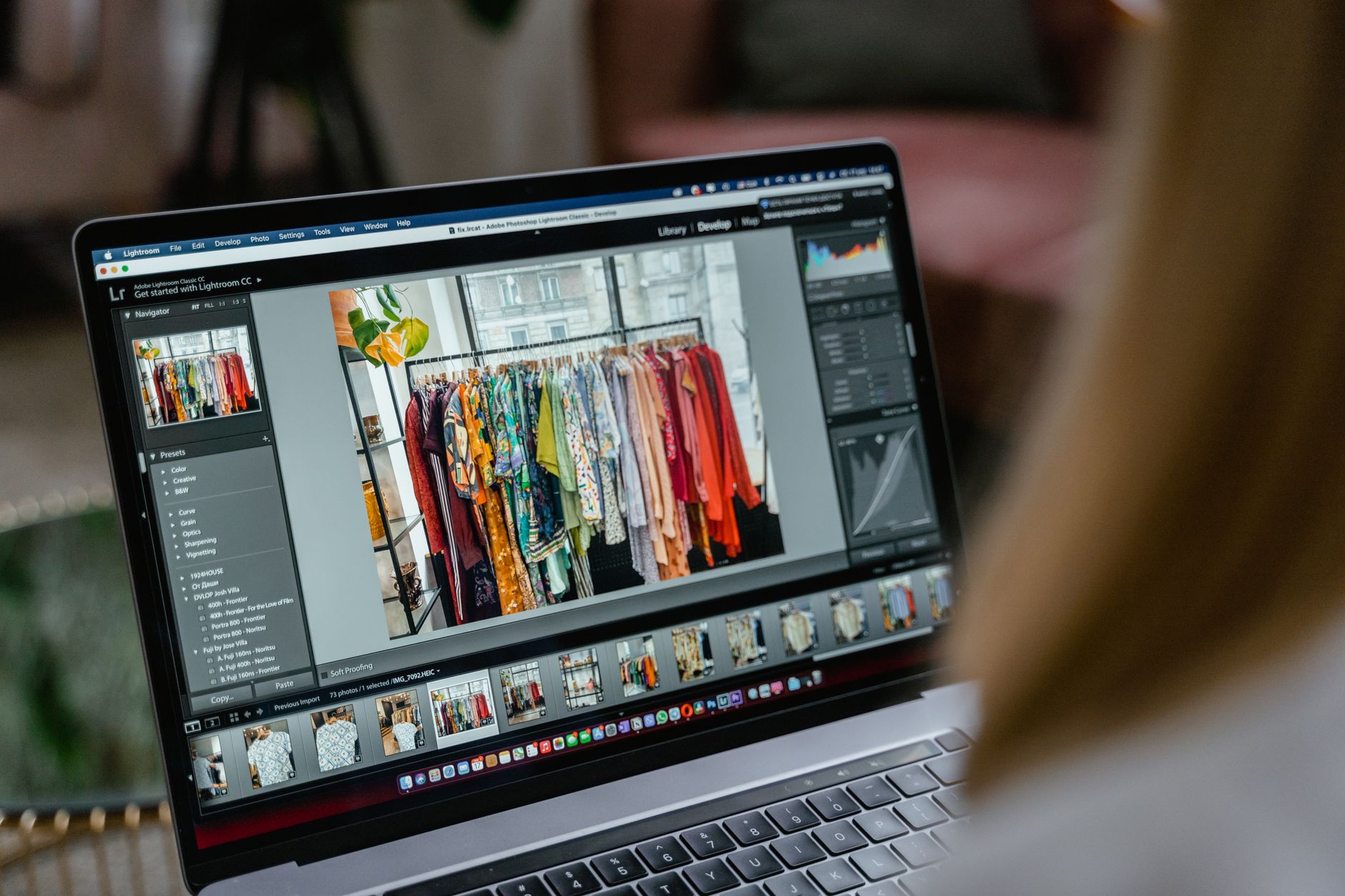
Adobe Lightroom occupies a unique middle ground in this product photo editing software comparison—more powerful than Canva for photographic adjustments, yet far more approachable than Photoshop for sellers who don’t need pixel-level manipulation. Its core design philosophy revolves around non-destructive editing and batch processing, which makes it the tool of choice for sellers who photograph their own inventory in-house.
The Batch Processing Advantage
Lightroom’s “Sync Settings” feature is arguably its single most valuable capability for product photographers. Once you dial in the perfect exposure, white balance, and color grade on one photo, you can apply those exact settings to hundreds of other images shot under the same lighting conditions in seconds. For sellers who photograph an entire product line in one session, this cuts editing time from hours to minutes.
Presets take this further. Many sellers build a custom preset library tailored to their specific lightbox, softbox, or studio setup, then apply it to every new shoot going forward. Once that preset library is dialed in, new product photos can go from “camera roll” to “ready to upload” in under two minutes each, even before any AI acceleration is added to the workflow.
Lightroom’s Limitations for E-Commerce
Lightroom’s Achilles’ heel is background manipulation. While recent versions have added AI-powered “Select Subject” and background replacement tools, they’re noticeably less refined than dedicated background removal tools. Fine details—jewelry chains, mesh fabric, glass edges—often need manual cleanup after the automated selection, which defeats some of the time savings that drew sellers to Lightroom in the first place.
This is exactly the gap where a dedicated AI Background Remover earns its place in a modern workflow: sellers increasingly do their color and exposure batch work in Lightroom, then run final cutouts through a specialized tool that’s been trained specifically on product edges, hair, and translucent materials. The two tools aren’t competitors so much as complementary stages of the same pipeline.
Adobe Photoshop for Product Photography: Maximum Control, Maximum Complexity
Photoshop remains the industry standard for detailed, pixel-level product photo editing—but that power comes at the cost of speed and accessibility. In any product photo editing software comparison, Photoshop represents the ceiling of what’s technically possible, while also representing the steepest learning curve and the most time-intensive workflow per image.
When Photoshop Is Worth the Learning Curve
For compositing multiple product angles into a single hero image, building complex shadow and reflection effects, or performing frequency separation retouching on high-end product photography (think luxury watches, cosmetics, or jewelry), nothing else in this comparison comes close. Photoshop’s layer-based, non-destructive editing lets you stack dozens of adjustments and revert or tweak any one of them at any time.
Photoshop Actions—recorded sequences of edits that can be replayed on new images—partially close the batch-editing gap with Lightroom. A well-built Action set can automate resizing, sharpening, watermarking, and basic color correction across a folder of images in one pass. But building and maintaining that Action library requires real technical investment, and it still can’t match Lightroom’s Sync Settings for sheer simplicity.
The Real Cost of Photoshop for Small Sellers
Beyond the $22.99–$34.99 monthly subscription, the actual cost of Photoshop is time. Most sellers report 3–6 months before they’re comfortable enough with the tool to edit efficiently, and mastery of advanced techniques like frequency separation or luminosity masking can take a year or more of regular practice. For a solo seller listing 15 products a month, that investment rarely pays for itself compared to faster alternatives. For a brand shooting 500+ SKUs a year with a dedicated photo editor on staff, it often pays for itself many times over.
Where AI Photo Editing Tools Now Outperform Traditional Software
Any product photo editing software comparison written in 2026 has to reckon with a shift that wasn’t fully mainstream even two years ago: purpose-built AI tools now handle several core product photography tasks faster and, in many cases, more accurately than the general-purpose software they were designed to replace.
Background Removal: The Clearest Win for AI
Generic background removers in Canva, Lightroom, and even Photoshop’s “Select Subject” tool are built to handle any kind of image—portraits, landscapes, products, screenshots. A specialized AI Background Remover trained specifically on product photography edge cases (glass, jewelry chains, translucent fabric, fine mesh) consistently produces cleaner cutouts with less manual cleanup. For sellers processing large batches, that difference compounds fast: shaving even 30 seconds of manual touch-up off each of 300 images saves 2.5 hours per catalog update.
Studio Backgrounds Without a Studio
Traditional workflows required either a physical studio setup or hours of manual compositing in Photoshop to place a product convincingly into a lifestyle scene. AI Product Photography tools now generate photorealistic studio and lifestyle backgrounds directly from a plain product cutout, which is especially valuable for sellers who can’t afford a studio rental or a full-time photographer. This doesn’t replace Photoshop for high-end compositing work, but for the vast majority of standard e-commerce listings, it removes an entire production step.
Resolution Recovery for Zoom-Heavy Listings
Marketplaces like Amazon and Etsy increasingly reward listings with high-resolution, zoomable images, but many sellers still shoot on older phones or inherit low-resolution supplier photos. Rather than trying to fix this in Photoshop with basic bicubic resizing (which often introduces visible softness or artifacts), an AI Image Upscaler can recover convincing detail and sharpness, making older or smaller source images usable again without a reshoot.
Founder and Team Photos for Brand Pages
It’s not just product shots that need editing attention. “About Us” pages and founder bios convert better with professional headshots, but hiring a photographer for a two-person team is rarely worth the cost. AI Headshots tools let small teams generate polished, consistent professional portraits without a studio session, which rounds out the brand presentation alongside well-edited product photography.
Which Product Photo Editing Software Should You Choose in 2026?
The honest answer from this product photo editing software comparison is that most growing sellers end up using more than one tool, not a single “winner.” The real decision isn’t Canva vs. Lightroom vs. Photoshop in isolation—it’s building a stack that matches your volume, product type, and available time.
By Seller Profile
- New or solo sellers under 20 SKUs/month: Canva plus a free AI Background Remover covers 90% of needs without any subscription commitment beyond Canva Pro.
- Growing sellers shooting in-house (20–200 SKUs/month): Lightroom for batch color/exposure work, paired with AI background removal and upscaling tools for final c