![Image Quality vs Sales: What the Data Shows [2026 Study]](https://pixelpanda.ai/blog/wp-content/uploads/2026/01/image_c2c52b35d8f20f35af5e0c3605944058.jpeg)
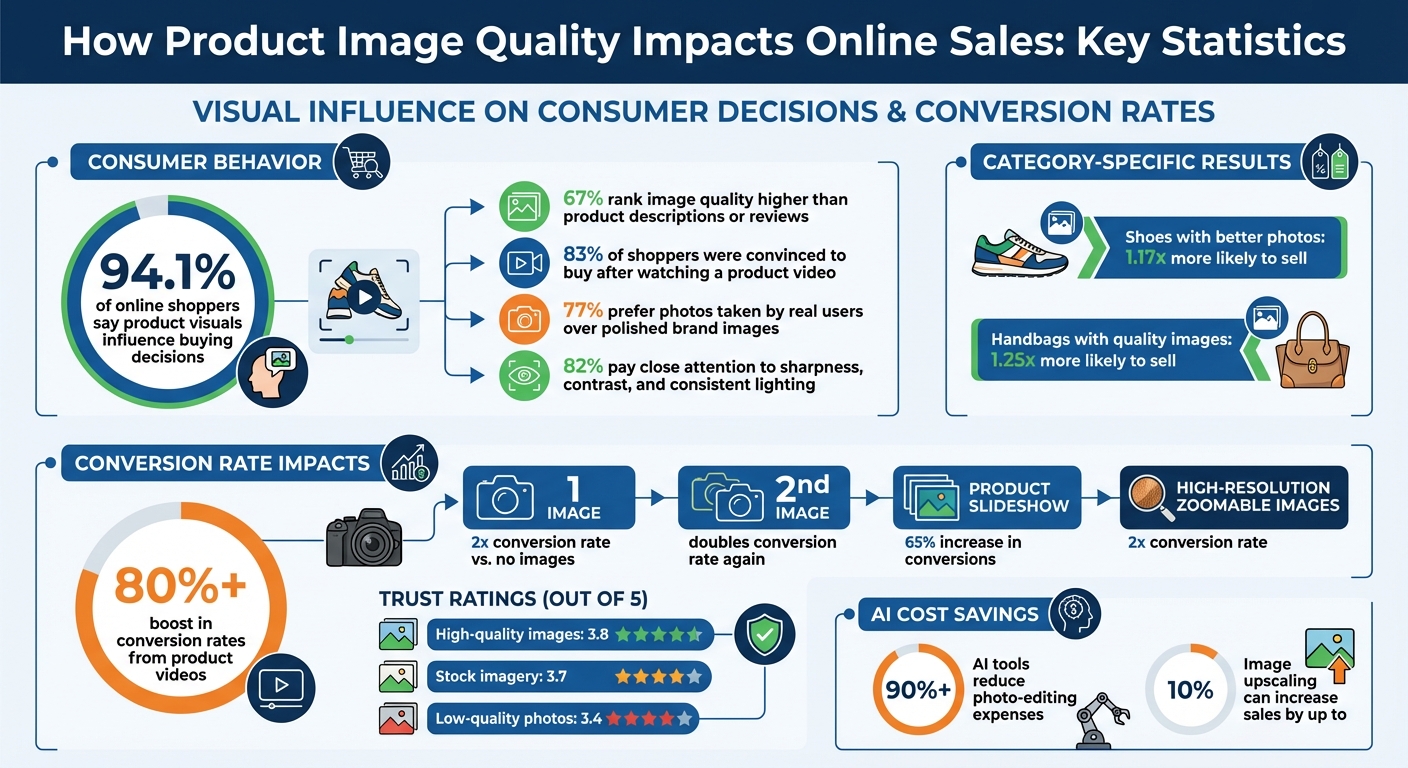
High-quality product images can significantly boost online sales. Research shows that 94.1% of online shoppers say product visuals influence their buying decisions, and 67% rank image quality higher than product descriptions or reviews. Poor images drive customers away, while clear, professional visuals build trust and improve conversions.
Key insights include:
- Listings with multiple, high-resolution images double conversion rates.
- Shoes with better photos are 1.17x more likely to sell; handbags see a 1.25x increase.
- Videos on product pages can boost sales by 80% or more.
- AI tools like PixelPanda make it easier and cheaper to create polished, detailed visuals.
Takeaway: Investing in better product images leads to higher sales, fewer returns, and stronger customer loyalty.
How Product Image Quality Impacts Online Sales: Key Statistics
Research Findings: How Image Quality Affects Sales
Data Points From the Study
A study by eBay Research Labs revealed some eye-opening insights about the role of images in online sales. Listings with just one image saw conversion rates double compared to those without any images. Adding a second image? That doubled the rate again! Including a product slideshow increased conversions by 65%, while high-resolution, zoomable images doubled them once more. And here’s a standout stat: product pages with videos can boost conversion rates by 80% or more. In fact, 83% of shoppers said they were convinced to buy after watching a product video.
But it’s not just about having visuals – how those visuals look matters, too. Technical aspects like higher contrast, warmer tones, background removal, larger key objects, and greater depth-of-field all contribute to stronger sales performance. Additionally, 82% of users pay close attention to details like sharpness, contrast, and consistent lighting when evaluating product photos. These visual elements act as subtle psychological cues that influence buying decisions. Clearly, image quality isn’t just a nice-to-have – it’s a game-changer for sales.
And if the numbers aren’t convincing enough, real-world examples drive the point home.
Case Examples of Better Images Increasing Sales
Controlled studies have shown that marketplaces using high-quality images scored 3.8 out of 5 in meeting customer expectations. In comparison, stock imagery scored slightly lower at 3.7, and low-quality photos trailed at 3.4. Authenticity also plays a big role – 77% of online shoppers say they prefer photos taken by real users over polished, brand-produced images. These findings highlight how much consumers value genuine, high-quality visuals when making purchasing decisions.
sbb-itb-76ad1b7
Why Your Product Images Could Be Killing Your Sales with Siddharth Sinha
Research Methods Used in the Study
To explore the connection between image quality and sales, researchers employed a combination of computational analysis, experiments, and real-world data. This multi-method approach helped uncover the mechanisms behind how image quality influences consumer behavior. These methods set the stage for the computational and econometric analyses that followed.
A team from Cornell Tech, led by doctoral student Xiao Ma, developed a deep learning algorithm capable of classifying product images with an impressive 87% accuracy. The team analyzed thousands of photos from platforms like eBay and Letgo.com, training the model to rate images as “good”, “fair”, or “poor.” To further validate the findings, they brought in 300 participants to evaluate three hypothetical online marketplaces, each featuring products with varying image quality levels. By isolating image quality as the sole variable, they measured its impact on consumer trust and purchase intent.
Using computational techniques, researchers identified key visual cues that grab shopper attention. For example, the saliency region method predicted where consumers’ gaze would land by analyzing the size of key objects within an image relative to the frame. Additionally, entropy analysis measured visual complexity by assessing color variation, while face detection algorithms tracked the presence of human figures to examine their influence on social connection. In 2014, Xin Li and colleagues from the City University of Hong Kong applied these techniques to data from Mogujie.com, a Chinese social shopping site, using “likes” as a stand-in for purchase intent.
To strengthen these findings, researchers turned to econometric models to establish causal relationships. They used methods like the “first difference” approach and “instrumental variables estimation” to confirm that high-quality images directly drive higher sales, rather than simply correlating with popular products. One study revealed that a high-quality image could influence price perception as much as adding 2,856 words to a product description. The impact was even more pronounced in specific categories: shoes with better photos were 1.17 times more likely to sell, and handbags with higher-quality images were 1.25 times more likely to find buyers.
“Understanding how images mediate interactions in online marketplaces could improve the efficiency of these marketplaces dramatically.” – Xiao Ma, Lead Researcher, Cornell Tech
What This Means for Online Retailers
The quality of your product images can make or break your sales. In the online shopping world, where customers can’t physically touch or examine items, photos become the key to building trust. Poor-quality images create doubt, leaving customers unsure about what they’re actually buying. This hesitation often leads to abandoned carts and lost revenue. Let’s take a closer look at how image quality influences buying behavior.
The evidence is striking. A January 2019 Cornell Tech study found that marketplaces with low-quality images earned trust ratings of just 3.4 out of 5, compared to 3.8 for those with high-quality photos. When 94.1% of shoppers say product images affect their buying decisions, and 83.6% link their final choice directly to visual presentation, the takeaway is clear.
Subpar visuals don’t just damage trust – they also discourage repeat business. Blurry photos, poor lighting, or a lack of detail make shopping harder, creating unnecessary friction. Frustrated customers often turn to competitors with clearer, more professional images. On top of that, misleading or inaccurate photos lead to higher return rates, further eroding customer confidence.
“Without face-to-face interactions there is a lot of uncertainty. You don’t know what’s going on on the other side of the screen.” – Xiao Ma, Lead Author of “Understanding Image Quality and Trust in Peer-to-Peer Marketplaces”
On the flip side, professional-quality images can significantly boost conversions. In some categories, the difference is especially dramatic. For example, the Cornell study revealed that shoes with high-quality photos were 1.17 times more likely to sell, while handbags saw a 1.25x increase in sales when photographed professionally.
How Better Images Change Buying Decisions
High-quality product images do more than just show what an item looks like – they create an emotional connection. Experts call it a “virtual test drive”, where detailed, zoomable photos let shoppers imagine owning and using the product. This mental experience often tips the scales toward making a purchase.
The technical aspects of artificial intelligence image editing and quality matter more than you might think. Bright lighting, sharp contrast between the product and background, and warm color tones can inspire confidence and positive emotions. Even small details, like following the rule-of-thirds in composition, make images feel more polished and trustworthy. On the other hand, embedding prices directly into product images can actually lower their appeal, reducing their attractiveness rating by about 0.39 points on a 5-point scale.
“Image quality is not just a design choice – it’s a psychological signal influencing purchase intent.” – Emily Tran, Insights Author, JU Productions
Shoppers today expect a variety of detailed images – typically 5 to 8 per product. These should include multiple angles, close-ups of textures, and lifestyle shots that provide scale and context. High-resolution, zoomable images allow customers to inspect products as if they were holding them in their hands. By offering this level of detail, you eliminate uncertainty and make it easier for customers to click “Buy.”
Clear, detailed visuals also reduce the need for customers to ask questions, speeding up the decision-making process. This is especially important for mobile shoppers, who often make quick choices on smaller screens. The result? Fewer abandoned carts and more completed checkouts.
Using Better Images to Build Customer Loyalty
Great product images do more than drive initial sales – they help build long-term customer loyalty. When shoppers receive products that match what they’ve seen online, they’re less likely to feel disappointed. Accurate color representation and detailed visuals ensure that expectations align with reality, reducing the chances of negative reviews and returns.
Interestingly, 77% of buyers say they prefer seeing real photos from other customers alongside polished brand images. This highlights a key insight: shoppers value authenticity, but they also expect professional quality. The ideal balance is high-quality photos that feel genuine, like user-generated content, but still showcase the product clearly. Research by Xiao Ma confirms that these types of images outperform both stock photography and low-quality snapshots when it comes to building trust.
Video content takes things a step further. Product pages featuring videos can increase conversion rates by 80% or more, with 83% of consumers saying they’ve been convinced to buy after watching a product video. Videos capture details that photos can’t, like how fabric moves, how hardware functions, or how a product looks from every angle. This deeper visual experience reinforces confidence and builds stronger customer relationships.
Professional visuals pay off in the long run. First-time buyers who are satisfied with their purchase are more likely to become repeat customers. They leave positive reviews, often including their own high-quality photos, which creates a cycle of trust and credibility. These happy customers are less likely to return products, saving you money and reducing waste. Most importantly, they remember the brands that gave them confidence – and they come back for more.
Using AI Tools to Improve Image Quality
AI tools have revolutionized image editing, making it faster, cheaper, and more accessible. Tasks that once required expensive equipment and professional photographers – like background removal, lighting adjustments, and cropping – are now handled effortlessly by AI-powered platforms. These tools not only simplify editing but also help businesses create professional-quality visuals that build trust with customers and drive sales. For small businesses competing against larger retailers, this technology has become a game-changer, leveling the playing field by offering affordable, high-quality solutions.
The cost savings are staggering. AI tools can cut photo-editing expenses by over 90% compared to traditional methods. A Photoroom survey conducted in April 2025 across 1,000 U.S. and U.K. clothing brands revealed that businesses using AI for tasks like background removal and lighting adjustments not only reduced costs but also refreshed their product catalogs quarterly. This frequent updating led to higher conversion rates and better average selling prices. Nearly half of these brands now update product images every three months – a pace that would be nearly impossible without AI.
AI also ensures brand consistency across all platforms by standardizing elements like lighting, background styles, and color grading. Plus, these tools can quickly create multiple variations of a single product image, making it easy to A/B test different visuals to see which ones resonate most with customers.
PixelPanda is one example of how AI advancements are making professional-quality visuals accessible to all retailers, regardless of size.
PixelPanda Tools for Better Product Photos

PixelPanda offers a suite of AI-driven features tailored for online sellers. Its background removal tool delivers clean, polished images that boost customer trust and purchase intent. The platform also includes an image upscaling feature, which eliminates pixelation and allows customers to zoom in on product details without losing quality – a feature that can increase sales by up to 10%. Additionally, PixelPanda creates lifestyle product photos, helping shoppers imagine how products fit into their lives.
One standout feature is the AI fashion studio, which enables virtual try-ons and outfit swapping. This tool showcases products on diverse body types and ethnicities without requiring costly photoshoots. PixelPanda also supports the creation of user-generated content (UGC)-style video ads with multi-language voiceovers in up to 35 languages, ensuring your visuals connect with a global audience. All images and videos come with commercial usage rights, so you can confidently use them across your sales channels.
Affordable Options for Small Business Owners
PixelPanda’s pricing structure is designed to make professional-quality visuals accessible to small businesses. By reducing costs and speeding up updates, these plans directly support the improved conversion rates mentioned earlier.
- The Starter plan costs $39/month (billed annually) and provides 7,000 credits, enough to create 350 videos or 7,000 images. It’s perfect for small shops experimenting with AI-enhanced product photography.
- The Growth plan is priced at $59/month and includes 15,000 credits, allowing for 750 videos or 15,000 images.
- The Pro plan, at $89/month, offers 35,000 credits, ideal for businesses managing larger product catalogs.
All plans include essential features like 1-minute video lengths, support for 35 languages, product holding, and outfit swapping. For small business owners who might have spent thousands on a single professional photoshoot, these monthly costs are a fraction of traditional expenses, offering unmatched speed and flexibility.
Conclusion
Research shows that top-notch product images play a major role in driving sales. In fact, 94.1% of online shoppers say product images influence their buying decisions, and 67% rank image quality above product descriptions or reviews. Clear, professional visuals not only make products more appealing but also help build trust – turning casual browsers into paying customers while cutting down on costly returns.
Retailers who can consistently produce high-quality imagery at scale gain a strong edge over competitors. Thanks to AI-powered tools, what once required significant investment and expertise is now more accessible. These tools provide the consistency and variety today’s shoppers expect, leveling the playing field for businesses of all sizes – especially smaller ones. It’s a clear reminder of how impactful great visuals can be in the world of digital retail.
Here’s the key takeaway:
“Investing in premium product photography isn’t a ‘nice-to-have.’ When implemented rightly, strong visuals lift conversion rates, reduce returns, and elevate trust.”
- Emily Tran, JU Productions
PixelPanda is a prime example of how technology makes this possible. With features like background removal, image upscaling, AI-generated lifestyle shots, and virtual try-ons, PixelPanda’s tools bring professional-grade image capabilities to businesses of every size.
Simply put, better images lead to better business results. Whether you’re focusing on your highest-margin items or revamping your entire product catalog, investing in quality visuals pays off – with higher conversion rates, fewer returns, and stronger customer loyalty.
FAQs
How does the quality of product images impact online sales?
High-quality product images are a game-changer when it comes to increasing online sales. They build customer confidence, make products more enticing, and give shoppers a clear, accurate look at what they’re buying – which can help minimize returns. When customers can view sharp, professional visuals, they’re much more likely to hit that “Buy” button.
On top of that, polished visuals elevate the entire shopping experience. They make your online store feel more trustworthy and engaging. Simply put, investing in high-quality images isn’t just about aesthetics – it’s a smart move that can boost conversions and grow your revenue.
How can AI tools improve product images for small businesses?
AI tools are revolutionizing how small businesses create product images by making complex editing tasks easier and producing professional-grade visuals. With features like background removal, image upscaling, and AI-generated product photos, these tools help businesses showcase their products in a polished and consistent manner.
By automating tedious processes, AI enables businesses to refresh their product visuals more often, cutting costs and speeding up the time it takes to bring products to market. High-quality visuals don’t just look good – they build trust, boost customer engagement, and drive sales. For small businesses aiming to stay competitive, AI-powered tools are quickly becoming a game-changer.
Why are product videos more effective than images for increasing sales?
Product videos outperform images because they bring products to life, showing them in action and offering a closer, more realistic look. This helps potential buyers understand how a product works, its actual size, and key features in real-world settings – details that static images often fail to capture.
By answering common questions and addressing uncertainties, videos improve the shopping experience and can lead to better conversion rates and fewer returns. For many shoppers, seeing a product in motion makes it feel more genuine and reliable, playing a key role in their decision-making process. In short, videos provide an engaging and dynamic way to connect with customers and inspire confidence in their purchase.