AI product photography is transforming e-commerce by cutting costs, saving time, and scaling effortlessly. Here’s the key takeaway: AI-generated images cost as little as $0.10 per image and take minutes to produce, compared to traditional shoots that cost $50–$500 per image and take weeks. However, traditional methods still excel in precision and realism, especially for luxury products or intricate textures.
Key Points:
- Cost: AI saves up to 90% on production costs, ideal for small businesses and large catalogs.
- Speed: AI delivers images in minutes, while traditional shoots take weeks.
- Scalability: AI handles bulk production efficiently, unlike traditional methods that scale costs with volume.
- Use Cases: AI is perfect for budget-friendly, high-volume needs like e-commerce catalogs, while traditional photography suits luxury brands and campaigns where detail and trust are critical.
Quick Comparison:
| Feature | AI Photography | Traditional Photography |
|---|---|---|
| Cost per Image | $0.10–$15 | $50–$500 |
| Turnaround Time | Minutes to hours | 1–4 weeks |
| Scalability | High (flat costs) | Costs rise with volume |
| Detail & Realism | Limited | High |
| Best For | High-volume catalogs | Luxury, detailed products |
AI is reshaping product photography, but the best approach often blends both methods: use traditional photography for hero images and AI for scalable, routine needs.
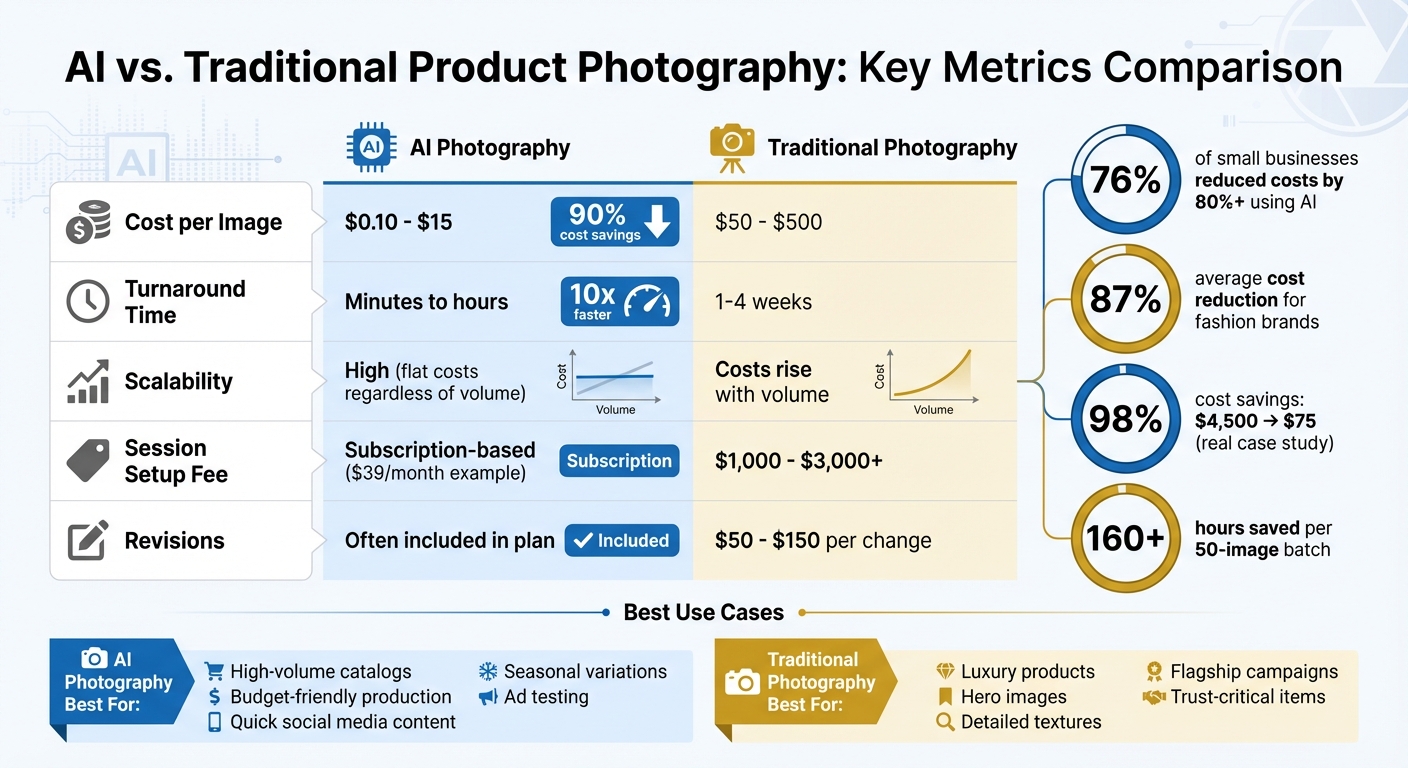
AI vs Traditional Product Photography: Cost, Speed and Scalability Comparison
She made THIS with AI!? | Tips for E-commerce Product Photography
Comparing AI and Traditional Photography: Key Metrics
Choosing between AI and traditional photography isn’t just about picking "modern" over "classic." These two methods differ significantly in terms of cost, speed, and scalability – key factors that can make or break your business operations.
Traditional photography comes with hefty upfront costs. Studio rentals range from $200 to $1,000 per day, photographers charge between $150 and $500 per hour, and hiring models and stylists can add $100 to $600 per day. Add it all up, and a single photoshoot can quickly climb to $1,000 or even surpass $3,000.
AI photography, on the other hand, eliminates most physical expenses. For example, PixelPanda’s Starter plan costs $39 per month and covers up to 7,000 credits, cutting out the need for studios, equipment, or travel costs entirely.
Time is another major differentiator. Traditional photoshoots can take 2 to 6 weeks from planning to final edits. AI photography slashes this timeline to hours or even minutes: briefing takes 1 to 2 hours, image generation 30 minutes to 4 hours, and final tweaks under 45 minutes. This makes the entire process around 10 times faster.
Scalability is where AI shines brightest. Traditional photography costs scale with volume – producing 500 images means booking more sessions, hiring more models, and spending significantly more. AI, however, maintains flat costs regardless of volume. In November 2024, a boutique fashion store saved 98% on photography costs by switching from traditional methods to AI, cutting their expenses from $4,500 to just $75 while launching their collection nearly instantly.
| Metric | Traditional Photography | AI Photography |
|---|---|---|
| Cost per Image | $55 – $500 | $0.75 – $15 |
| Session Setup Fee | $1,000 – $3,000+ | Subscription-based (e.g., $39/month) |
| Turnaround Time | 1 – 4 weeks | Minutes to hours |
| Revisions | $50 – $150 per change | Often included in the plan |
| Scalability | Costs increase with volume | Low; handles bulk production easily |
Cost and Budget Differences
Traditional photography costs anywhere from $55 to $500 per image, while AI-generated images cost as little as $0.75 to $3.00 each. For small businesses, this price gap is game-changing. A survey found that 76% of small businesses using AI tools reduced production costs by over 80%, largely by eliminating studio and logistics expenses. These savings not only simplify workflows but also free up budgets for other priorities like improving conversion strategies.
Fashion brands, in particular, see massive savings. Data shows an average cost reduction of 87% when switching to AI photography. One e-commerce brand with over 500 SKUs cut its annual photography budget from $50,000 to just $800 – saving $49,200, which it reinvested into marketing. This reinvestment reportedly helped triple the brand’s revenue.
AI platforms like PixelPanda operate on a credit-based model, avoiding additional costs for equipment, studio rentals, or travel. Revisions are another area where AI offers savings. Traditional reshoots or edits can cost $50 to $150 per change, while AI plans often include unlimited revisions.
Time and Efficiency
Speed is a critical advantage in today’s fast-paced market. Traditional photography involves booking studios, coordinating schedules, shipping products, and waiting through lengthy post-production timelines. In contrast, AI can generate 50+ images in under 6 hours, saving over 160 hours per batch.
Traditional methods can take up to 3 weeks from concept to final delivery, while AI reduces this timeline to as little as 1 to 2 hours. For brands launching seasonal collections or responding to trends, this speed isn’t just helpful – it’s essential.
"Deciding between an AI photoshoot vs traditional photoshoot is not only about creative preference. It is a strategic decision that impacts margins, timelines, and sales performance."
- Khushi Sharma, Content Writer, Advertflair
In 2025, Leena Kapoor, Founder of Coastline Apparel, reduced photoshoot days by 80% and cut catalog production time by 75% by shifting 90% of her product page creation to an AI platform. This allowed her to reserve traditional studio time for high-impact seasonal campaigns.
Scalability and Volume Production
When it comes to scalability, AI is in a league of its own. Traditional photography struggles to keep up with high-volume demands. Producing 1,000 images requires more studio days, models, and crew, along with higher costs. AI, by contrast, can handle 1,000 SKUs in nearly the same time and at almost the same cost as it would for 10 SKUs.
This scalability is a game-changer for brands with large catalogs. Traditional methods face physical constraints like limited studio capacity and model availability, often producing only 1 to 3 variations per product. AI platforms can generate 10 to 50+ variations per product almost instantly. AI also ensures consistent lighting, angles, and styling across an entire catalog – something that’s notoriously difficult with traditional methods.
Ravi Desai, Head of Ecommerce at Home Modern, achieved a 65% reduction in creative costs and a 2-day turnaround for local market catalogs by using a hybrid model. He combined a single traditional shoot with AI-generated variations to localize imagery for different regions.
"AI product photography is not replacing traditional shoots – it is complementing them, offloading the burden of scale, and unlocking boundless creative experimentation."
Many brands are now adopting this hybrid approach: conducting one high-quality traditional shoot for core product images and then leveraging AI to create hundreds of lifestyle and seasonal variations. This strategy ensures 100% product accuracy while offering nearly unlimited creative flexibility at minimal cost.
Benefits of AI Product Photography
AI product photography doesn’t just cut costs and boost efficiency – it also delivers a range of perks that directly improve e-commerce performance.
Lower Costs for Small Businesses
For small businesses, AI product photography can slash visual content production costs by an impressive 90% to 95%. By eliminating traditional expenses like photographer fees, studio rentals, model bookings, and travel, businesses can focus their budgets elsewhere. Take PixelPanda’s Starter plan, for example: at just $39 per month, it processes images for about $0.10 each. Compare that to traditional photography, where a catalog of 100 products with 5 images each could cost up to $50,000 – AI can bring that down to roughly $2,188.
Revisions are another area where AI shines. While traditional photographers may charge $50 to $150 per revision, most AI platforms include unlimited edits in their subscription plans. Plus, these platforms can automatically generate images that meet strict marketplace standards, like Amazon’s pure white background (RGB 255,255,255) and 2000x2000px resolution. This combination of cost savings and compliance makes AI a game-changer for businesses looking to scale quickly.
Fast Content Creation and Flexibility
AI tools can produce professional-grade images in just 2 to 5 minutes, allowing brands to respond to market trends almost instantly. This speed also enables unlimited creative variations from a single photo, which is perfect for testing and refining marketing strategies. For instance, brands can quickly experiment with different visuals to find the one that resonates most with their audience.
In April 2024, fashion brand Stradivarius launched its first fully AI-driven campaign, featuring virtual models and editorial backgrounds. This approach not only cut costs but also pushed creative boundaries by eliminating traditional production constraints.
"AI product photography isn’t about replacing creativity; it’s about scaling it with consistency, precision, and speed."
- Veruska Anconitano, Photoroom
The ability to create content quickly and at scale is a huge advantage for brands aiming to stay competitive.
Easy Scaling for Large Product Catalogs
Whether you’re working with 10 SKUs or 1,000, AI makes scaling simple and efficient. Tools like PixelPanda support bulk processing through ZIP uploads or API integrations, enabling entire catalogs to be processed in minutes. Unlike traditional methods that require individual shoots for each product, AI ensures consistent lighting, shadows, and framing across the board.
A great example of this is GoodBuy Gear, a secondhand marketplace that, in 2025, standardized imagery for over 42,000 products. This move resulted in a 23% boost in conversion rates. Many brands are now adopting a "shoot once, scale with AI" approach – capturing a single high-quality image and using AI to generate lifestyle, seasonal, and ad-ready variations without needing additional photoshoots.
"The result? Same creative direction. Triple the output speed."
- Ioanna Nella, Growth Manager at Pixofix
AI also has the ability to upscale low-resolution supplier images by 2X, 5X, or even 10X without introducing noise. This means even lower-quality images can be transformed into polished, marketplace-ready assets, saving time and effort while maintaining quality.
Benefits of Traditional Product Photography
While AI-generated images may save time and reduce costs, there are situations where traditional photography stands out – particularly when authenticity and attention to detail are critical.
Better Realism and Detail
Traditional photography excels at capturing the intricate details that customers rely on to assess product quality. With professional cameras and lighting, it can highlight the depth of leather grain, the fine stitching in knitwear, or the natural flow of fabric. This level of precision brings out tactile nuances through the interplay of light and shadow. For complex surfaces like jewelry, glassware, or mixed textures, traditional setups can accurately showcase reflections, refractions, and the contrast between matte and glossy finishes. These details not only make the images more realistic but also help foster consumer trust.
Take the example of Sage & Stone, a Portland-based stoneware manufacturer. They initially turned to AI photography for new glaze variants, cutting costs by 62%. However, within six weeks, their return rate spiked from 8.3% to 12.7%, with customers complaining about color mismatches and flat-looking glazes. By shifting back to traditional photography for key product shots while using AI for lifestyle contexts, they achieved a 22% increase in add-to-cart rates and saw return rates normalize.
The importance of image quality is further highlighted by data showing that 67% of online buyers consider it the most influential factor in their purchase decisions. Additionally, subtle inconsistencies in AI-generated images – like mismatched seams or phantom reflections – can increase return rates by 1.8% to 4.2%.
Building Trust with Luxury Brands
Traditional photography plays an even bigger role in building trust, especially for luxury and premium brands. For these brands, it’s not just about showcasing details – it’s about reinforcing their credibility. High-end shoppers scrutinize every visual element, and professional photography acts as a "trust anchor", ensuring the product appears exactly as advertised.
"With luxury you are buying into a lifestyle, becoming part of that fantasy and identity… Consistency of brand image in the marketplace – through the use of photography – is ultimately what gives each label its unique status."
- Mike Diver, Photographer, Diver & Aguilar
Through careful lighting and composition, traditional photography allows brands to craft emotionally engaging stories. It reflects the craftsmanship and intentionality that AI often struggles to replicate. This storytelling ability explains why luxury brands continue to invest between $1,500 and $10,000 per studio session.
Even major online marketplaces back this approach. Platforms like Amazon and Flipkart require real product photography for main listings to ensure accuracy. AI-generated renders that misrepresent products are generally prohibited for primary images. For brands that prioritize trust and premium positioning, traditional photography remains the more reliable choice.
sbb-itb-76ad1b7
How Photography Type Affects Conversion Rates
The type of photography you choose doesn’t just impact cost and production time – it plays a direct role in driving sales. With visual content influencing 93% of purchasing decisions, the way your products are photographed can significantly affect customer engagement and conversion rates. Both AI-generated and traditional photography have their strengths, but their effectiveness often depends on the product category and target audience.
AI Photography and Customer Engagement
AI-generated images have a knack for boosting engagement by enabling quick and cost-effective creative iterations. These images can increase conversion rates by 35–40%, largely because they allow businesses to test multiple variations without the expense of traditional reshoots. For example, AI-powered banner ads often achieve up to 50% higher click-through rates compared to professionally shot stock photos.
One of AI’s standout features is its ability to personalize imagery based on customer data. By tailoring visuals – such as backgrounds or models – to match a visitor’s location, age, or browsing habits, businesses can see conversion rates rise by as much as 52%. Lifestyle imagery, which AI can generate from basic product photos, also performs well, delivering 22% to 30% higher conversion rates than standard white-background shots.
"Customers trust our brand more when every product looks professionally shot. The consistency AI provides is impossible to achieve manually." – Sarah Chen, Founder of StyleHub
Another key advantage of AI photography is speed. AI-generated images load up to 75% faster than traditional high-resolution files, reducing mobile bounce rates by 38%. This is especially important given that 60% of shoppers now make purchases on mobile devices. For instance, GoodBuy Gear used AI tools to standardize over 42,000 product images, resulting in a 23% higher conversion rate across their platform.
Traditional Photography for High-Value Sales
While AI shines in creating dynamic and personalized visuals, traditional photography remains the go-to choice for premium products where realism and trust are critical. High-value items often require precise representation of texture, color, and material to minimize buyer hesitation. Considering that 49% of online product returns happen because the item didn’t match its images or description, accuracy is non-negotiable in this space.
For luxury products, customers tend to scrutinize every detail before making a purchase. Traditional photography’s ability to capture the intricate drape of fabric, the sparkle of jewelry, or the exact shade of a product builds the trust needed to convert cautious shoppers into buyers. Investing in traditional photography for key visuals – such as hero images or flagship product launches – can lead to higher conversion rates and fewer returns in high-end markets.
"High quality images take away the biggest doubt that comes with shopping online: Will it really look like this?" – Daria Udalova, Founder of Brand Da
These findings underscore the importance of matching your photography approach to your product and market needs, ensuring that your visuals align with customer expectations and buying behavior.
Choosing Between AI and Traditional Photography
Picking the right photography method depends on your product type, budget, timeline, and overall brand goals. Factors like your product category, available resources, and how you want to position your brand will guide whether AI, traditional photography, or a mix of both is the best fit.
Here’s the general rule: AI is ideal for speed and scale, while traditional photography excels at realism and precision. Striking the right balance between these methods can cut visual content costs by 40% to 60% without sacrificing the quality your customers expect. Below is a guide to help you decide based on specific use cases.
| Use Case | Recommended Method | Reason |
|---|---|---|
| Luxury/High-End Jewelry | Traditional | Requires precise control over reflections and intricate details |
| Large Catalog Updates | AI | Faster and more cost-effective for bulk SKU updates |
| Apparel (Fit/Drape) | Traditional | AI struggles to replicate fabric movement accurately |
| Social Media/Ad Testing | AI | Enables endless creative variations and backgrounds |
| Flagship Brand Campaigns | Hybrid | Traditional for key visuals, AI for scaling additional assets |
Let’s explore when to choose AI, when to rely on traditional methods, and how combining the two can streamline your visual content strategy.
When to Use AI Photography
AI photography is a great option when you’re working with tight budgets, managing large product catalogs, or need quick creative testing. For example, if you’re launching a catalog with numerous SKUs or refreshing seasonal imagery, AI can cut production time by up to 75%, with costs ranging from just $0.10 to $15.00 per image.
This method is especially effective for routine catalog updates and social media content. Tools like PixelPanda make it easy to create diverse, on-brand visuals quickly. From background removalixelpanda.ai/free-tools/background-remover”>background removal to virtual lifestyle scenes featuring models of various body types and ethnicities, AI tools can handle it all. With pricing starting at $39/month for 7,000 images, you can produce Amazon-ready white background shots, test multiple ad variations, and generate platform-specific visuals – all without stepping into a studio.
"AI product photography will replace traditional photography for low-cost, high-volume needs. However, brands that value a human approach may still choose to rely on traditional means for authenticity and full creative control." – Mike Lehman, Senior Content Strategist, Pikes
AI is particularly useful for testing creative ideas before committing to a full campaign. You can quickly generate variations with different backgrounds, seasonal themes, or lifestyle contexts in hours instead of weeks. This makes it an excellent choice for e-commerce brands that need to stay agile and respond quickly to market trends.
When to Use Traditional Photography
For products that require intricate detail or absolute accuracy, traditional photography is still the go-to choice. This is especially true for high-end products, flagship campaigns, and categories where precision is non-negotiable. For instance, if you’re selling jewelry with complex reflections or apparel where fabric drape and texture are key, traditional photography delivers the level of detail needed.
Certain marketplaces also have strict requirements that favor traditional photography. Platforms like Amazon Fashion, Myntra, and Ajio often mandate real model photography for apparel listings in order to meet their quality standards.
Traditional photography is worth the investment – typically $50 to $500 per image – when creating brand-defining visuals, like hero images. These are the primary product thumbnails customers see first, and they carry significant weight in driving conversions.
Combining Both Methods
One of the most efficient strategies is the "shoot once, scale with AI" approach. Start with a high-quality traditional shoot to capture accurate images, then use AI to generate hundreds of variations for seasonal, lifestyle, or platform-specific needs.
Leena Kapoor, founder of Coastline Apparel, reduced her photoshoot days by 80% and cut catalog production time by 75% by reserving studio sessions for high-value campaigns while using AI for 90% of routine product pages.
"AI doesn’t replace photographers – it replaces the bottleneck between design and deployment." – Lena Torres, Director of Creative Operations, Shopify Plus
To ensure quality, always have human oversight for AI-generated visuals. Use AI for repetitive tasks like background removal and initial edits, but have a human retoucher review the final outputs. This helps catch issues like floating shadows, distorted textures, or color mismatches before publishing.
Conclusion
Deciding between AI and traditional photography comes down to understanding the strengths of each method. Traditional photography excels when absolute precision is essential, such as for luxury items, flagship campaigns, or products where material accuracy builds trust. On the other hand, AI photography has revolutionized visual content creation for small businesses and high-volume catalogs, cutting costs by 70% to 90% and reducing production timelines from weeks to mere minutes.
The numbers paint a compelling picture. For small businesses working with limited budgets, the cost savings are game-changing – 76% of those using AI tools report reducing visual content production costs by over 80%. Tools like PixelPanda make this shift accessible, offering plans starting at $39/month for up to 7,000 images. This is enough to manage frequent catalog updates, social media posts, and ad testing, all without the hassle of studio bookings or paying for models.
A hybrid approach often delivers the best results. Traditional photography ensures impeccable detail and accuracy for hero images, while AI can quickly produce lifestyle variations, seasonal updates, and platform-specific visuals to broaden your content library. With 87% of retailers seeing revenue growth after adopting AI and the AI product photography market projected to hit $5 billion by 2035, the trend is hard to ignore. Combining both methods allows businesses to balance cost efficiency with high-quality visuals – key drivers behind the growing adoption of modern photography techniques.
Whether you’re a startup launching your first product or an established brand managing thousands of SKUs, your photography strategy should align with your priorities. Use traditional methods when precision is critical, rely on AI for speed and scalability, and blend the two to achieve efficiency without sacrificing quality.
FAQs
How does AI improve the quality and realism of product photography?
AI-driven photography is reshaping how product images are created, delivering high-quality, lifelike visuals with the help of advanced algorithms. These tools produce high-resolution, professional-grade images while cutting down on the time and expense typically associated with traditional photography. Features like precise background removal, lighting enhancements, and image upscaling ensure polished, ready-to-market visuals every time.
What’s more, AI opens the door to creating customized images, such as lifestyle settings or virtual try-ons, that connect with customers on a personal level. These realistic and interactive visuals not only make products feel more relatable but also help build trust. The result? Higher conversion rates and a big leap forward for eCommerce photography. AI isn’t just improving the process – it’s revolutionizing it.
How can AI-powered photography help small businesses save money?
AI-powered photography is a game-changer for small businesses, offering a budget-friendly way to produce high-quality images. Traditional product photography often costs between $50 and $150 per image, but AI-generated photos can cost less than $1 each. That’s a massive difference, making professional-grade visuals accessible without straining your budget.
Beyond cost savings, AI tools simplify the entire photography process. There’s no need to invest in pricey equipment, rent studios, or hire professional photographers. This efficiency allows small businesses to save both time and money, redirecting resources to other critical areas while still delivering impressive results.
When is traditional product photography a better choice than AI-powered solutions?
Traditional product photography works best when you need full creative control, intricate styling, or when your product’s specific requirements exceed what AI tools can currently handle. It’s especially useful for projects where the time and cost investment align with your artistic or branding objectives.
For instance, luxury brands or businesses crafting highly tailored campaigns often gain from the personalized touch and custom quality that traditional methods deliver. That said, for many other cases, AI-powered tools provide a quicker and more budget-friendly option while maintaining a professional look.