AI is transforming how online stores present products, making visuals faster, cheaper, and more effective. Here’s what you need to know:
- AI-generated product images cost under $1 each and take 15 seconds to create, compared to $39 and weeks for traditional photoshoots.
- Virtual try-ons reduce returns by up to 64% by showing clothes on diverse, realistic avatars that match body types and styles.
- AI-powered UGC-style videos mimic relatable user-generated content, boosting conversions by 38% and cutting production costs dramatically.
- Brands like Mango and Milaner have seen conversion rates soar (157% in Milaner’s case) using AI tools for visuals.
- The visual AI market is projected to reach $50.97 billion by 2030, with fashion and luxury sectors potentially gaining $275 billion in profits within five years.
AI tools simplify repetitive tasks, speed up product launches, and create visuals tailored to different audiences. Whether it’s automating product photos, enabling virtual try-ons, or generating engaging videos, AI is reshaping e-commerce visuals to drive sales and improve customer trust.
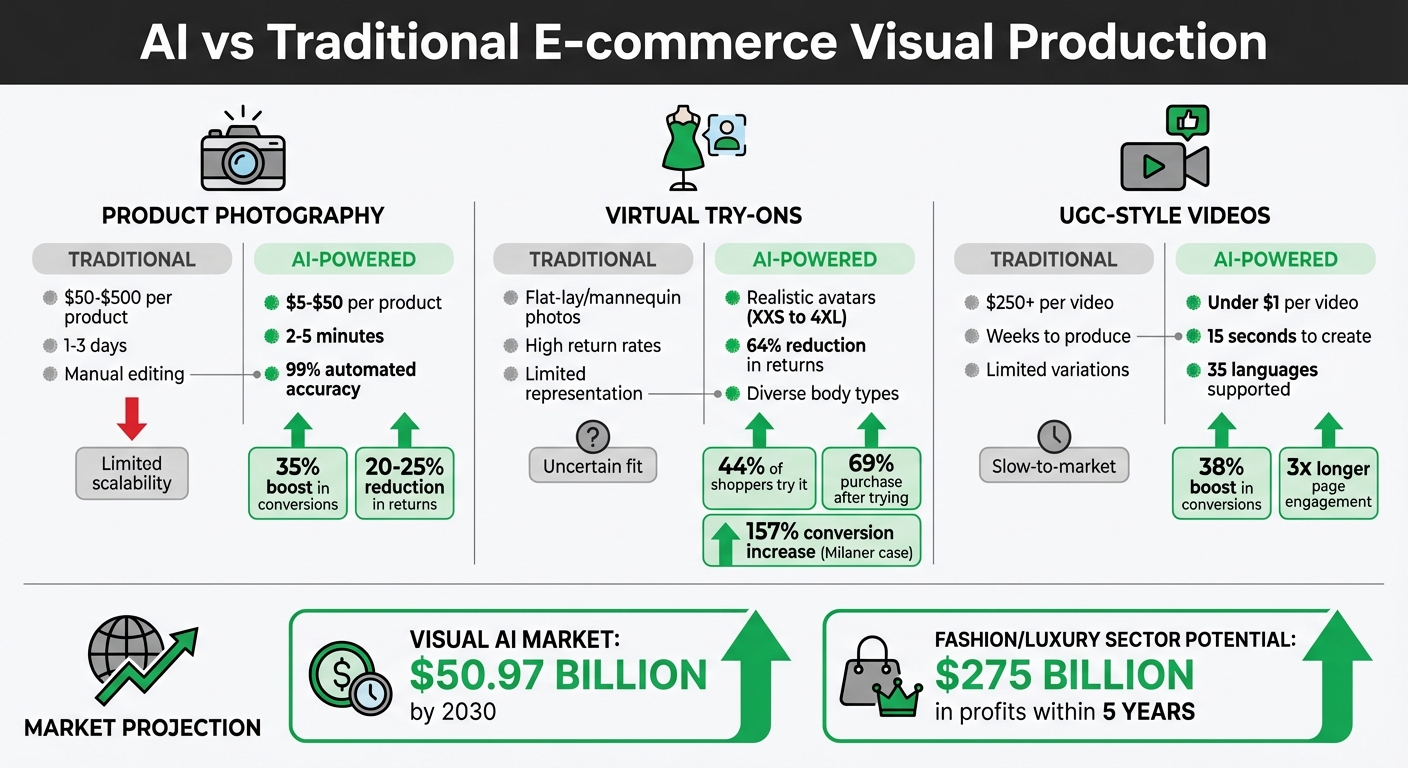
AI vs Traditional E-commerce Visual Production: Cost, Time & Performance Comparison
How Generative AI Is Redefining E-Commerce Storytelling | #BoFLive
AI-Generated Product Images: Professional Visuals at Scale
Traditional product photography can be expensive and time-consuming, costing anywhere from $50 to $500 per product and taking 1 to 3 days to complete. AI completely changes this dynamic. With costs dropping to just $5–$50 per product and processing times down to 2–5 minutes, AI has revolutionized how product catalogs are created. This isn’t just about saving money – it’s about speeding up product launches, making it easier than ever to bring new items to market.
The results are hard to ignore. Shopify stores using AI-generated images report a 35% boost in conversion rates and a 20–25% reduction in returns. GoodBuy Gear saw a 23% increase in conversions after processing 42,000 images with AI. Similarly, Textdrip’s experiments revealed a 38% higher click-through rate and a 22% improvement in landing page conversions.
"AI image generators have made things way faster and more consistent. We used to get random-quality photos from manufacturers. Now we can create clean, professional images in the same style." – Weston Blocker, CEO, NearTrade
Automating Product Photo Creation
AI technology eliminates the need for manual editing. Tasks like background removalixelpanda.ai/free-tools/background-remover”>background removal now achieve over 99% accuracy. Color correction happens automatically, and instead of working on one product at a time, you can process hundreds – or even thousands – simultaneously. Tools like PixelPanda can turn a simple smartphone photo into a studio-quality image, skipping the need for expensive lighting kits or elaborate setups.
One standout feature is automated scene generation. Upload a basic product photo, and AI can place it in a variety of settings – on a marble countertop, in a cozy living room, or even against a mountain backdrop. This is done without any physical photoshoots. AI can also create multiple views (side, top, back) from a single image. Need to showcase all available color options? AI can recolor the product, saving you from photographing each variant individually.
Batch processing takes this efficiency to another level. Entire product lines can be prepared in minutes instead of weeks. AI also ensures images meet platform-specific requirements – Shopify’s 2,048×2,048 pixel standard, Amazon’s white background rule, or Instagram’s unique aspect ratios – all formatted automatically. Low-resolution supplier photos? No problem. AI tools can upscale these images by 2x to 10x, removing noise and enhancing quality. Beyond technical improvements, AI ensures every image aligns with your brand’s visual identity.
Customizing Visuals to Match Brand Identity
Consistency across visuals is key to building trust with customers. AI tools allow you to create presets for lighting, padding, and background colors, ensuring every image aligns with your brand’s aesthetic. For example, PixelPanda lets you define a visual style once and apply it across your entire catalog – everything from lighting to framing stays consistent.
"Write prompts like you’re briefing a designer. Specify mood, layout, platform, and lighting." – Edward White, Head of Growth, Beehiiv
Detailed prompts make all the difference. Instead of saying "nice background", go for something like "rustic wooden kitchen counter with morning sunlight from the left". For products with intricate designs, AI’s image-to-image workflows use reference photos to lock in accurate shapes and textures, ensuring consistency across all angles.
PixelPanda combines features like background removal and image upscaling to standardize your catalog. Even if your photos come from multiple suppliers, the platform can unify them by removing distracting elements, enhancing resolution, and applying your brand’s visual guidelines. Consistent, polished imagery not only boosts conversions but also strengthens customer trust and recognition. The result? A professional-looking catalog that feels cohesive, even when sourced from a variety of vendors.
Virtual Try-Ons: Improving Customer Experience
One of the main challenges of online shopping is the "Imagination Gap" – that struggle to picture how a piece of clothing will actually look and fit on your body. Flat-lay shots and mannequin photos don’t do much to show how the fabric drapes, how the fit works, or how proportions play out. That’s where AI-powered virtual try-ons come in. By showcasing garments on realistic human models, these tools offer shoppers a much clearer idea of fit and style.
The impact on buying decisions is huge. 44% of shoppers have tried virtual try-on features, and an impressive 69% of them ended up purchasing the product. This not only boosts sales but also builds confidence in the buying process. When customers see a dress modeled on a body similar to theirs, they’re less likely to second-guess their choice. The result? Return rates drop by as much as 64%. Considering that 55% of online apparel shoppers return items because they look different in person, this is a game-changer.
Take Zalando, for example. In April 2023, they tested their virtual try-on software with select customers, allowing them to see how clothes would fit their unique body shapes. Under Reza Shirvany, Zalando’s Director of Applied Science, the trial led to a 40% reduction in returns for those categories. Similarly, Milaner, a luxury retailer, adopted AI-powered on-model imagery and saw a 157% jump in conversion rates and a 40% increase in shopper engagement.
"Virtual try-on allows people to dip their toe in the water and really build an emotional relationship with the brand." – Dorian Dargan, Co-founder and CEO, Doji
How Virtual Try-Ons Build Customer Confidence
Virtual try-ons tackle the biggest worries in online shopping: fit and style uncertainty. By showing garments on realistic models, they help customers visualize how the clothing will look on them. This visual reassurance removes much of the hesitation that often comes with buying online.
According to Shopify, products with virtual try-on features can see a 94% rise in conversion rates. And the engagement? AR-powered shopping experiences can boost interaction by 200%. Features like "Complete the Look" go even further, letting customers see a full outfit – dress, shoes, and bag – in a realistic setting. This makes it easier for shoppers to imagine how pieces work together.
PixelPanda’s AI Fashion Studio takes this concept up a notch. Brands can upload a flat-lay product photo and instantly generate on-model images tailored to their audience. Want to test different styles? You can create looks for a casual setting or a formal occasion and see which ones resonate more with shoppers.
Accuracy is key here. 71% of shoppers can’t tell the difference between real photos and AI-generated ones. But even small inaccuracies – like stitching errors or color mismatches – can break trust and lead to returns. If the AI-generated images don’t reflect the actual product, you’re back to the same problem as traditional photos: unmet expectations.
Diverse Avatars for Inclusive Marketing
Virtual try-ons aren’t just about fit – they’re about representation. 42% of shoppers feel underrepresented by standard model images on e-commerce sites. When customers don’t see themselves reflected in product visuals, they’re less likely to make a purchase. AI virtual try-ons solve this by offering a variety of avatars with different body types, skin tones, and ethnicities. Instead of relying on one model in one size, brands can showcase how a garment looks on avatars ranging from XXS to 4XL.
This approach also helps reduce returns. 76% of shoppers prefer on-model photos over flat lays because they better communicate how a garment fits and looks when styled. Seeing a product on an avatar that resembles their body type gives shoppers a clearer understanding of how it will fit, cutting down on sizing-related returns – which account for 87% of all product returns.
Localization becomes easier too. Brands can customize visuals for specific regions by selecting avatars that align with local demographics. For example, using Asian models for Japanese markets or diverse body types for campaigns in North America. PixelPanda’s AI Fashion Studio offers avatars with a wide range of body types and ethnicities, making it simple to create visuals that connect with audiences worldwide.
"Generative AI reduced a lot of the barriers for businesses, including ours, to innovate for customers." – Reza Shirvany, Director of Applied Science, Zalando
Transparency matters too. 59% of shoppers want brands to disclose when AI is used, seeing it as a sign of honesty and integrity. A small label like "Virtual Model" can help maintain trust without undermining the effectiveness of AI-generated visuals. The key is ensuring these images are accurate and realistic, so customers feel confident in their purchases.
sbb-itb-76ad1b7
UGC-Style Videos: Creating Authentic Content
AI-generated UGC-style videos are changing the game for e-commerce by delivering relatable, trust-building content that mimics real user-generated videos – without the usual production delays or high costs.
High-production ads often miss the mark, especially when 90% of consumers trust UGC over traditional advertisements. Real UGC, however, can take weeks to produce and cost upwards of $250 per video. AI tools solve this by creating videos that feel personal and genuine, using conversational scripts, realistic avatars, and everyday settings. These elements replicate the kind of content shoppers trust most – like a friend’s casual recommendation.
In September 2025, Andrew Yu, an e-commerce innovator, showcased how AI could produce realistic UGC ads for product detail pages. Brands using these videos saw a 38% boost in conversion rates and tripled the average time visitors spent on their pages.
"AI UGC ads mimic authentic user-generated content – the kind of short, relatable clips shoppers trust most." – Andrew Yu, E-commerce Content Creator
The numbers speak for themselves: 79% of consumers say UGC heavily influences their buying decisions, and brands using UGC see 29% more web conversions compared to those relying solely on traditional ads. This impact is even stronger among Gen Z, with 58% saying they’ve bought beauty or wellness products because of UGC.
Using AI for UGC-Style Video Ads
To create effective AI-generated UGC videos, start with a "Real Talk" script. Begin by addressing a relatable issue (like, "I’ve tried everything for dry skin…"), show the product in action, add a conversational review, and finish with a clear call to action. Keep videos short – 15 to 30 seconds – to match the fast-paced style of TikTok, Instagram Reels, and YouTube Shorts.
The visuals matter just as much as the script. AI tools can produce smartphone-style videos with natural lighting and casual settings that feel unscripted. This approach aligns with the 71% of consumers who want personalized shopping experiences powered by AI.
Take Eileen Lee of Nano Foam as an example. In 2025, she used AI-generated UGC ads to generate $69,000 in sales from a $19,000 ad spend, achieving a 3.73x ROAS. Her strategy involved creating multiple video variations – each with different hooks, avatars, and settings – to test which performed best with different audiences. This kind of batch production is something traditional UGC struggles to match due to creator availability and costs.
PixelPanda’s UGC-style video tool makes this process even easier. Brands can upload a product image, choose an AI avatar, and generate videos in minutes. With support for 35 languages and the ability to create up to 1,750 videos per month on the Pro plan, this tool enables brands to scale their content while maintaining the genuine feel that drives conversions.
"UGC-style content can actually boost engagement and revenue since it feels like something you can relate to." – Tanmay Ratnaparkhe, Co-founder, Predis.ai
To maintain transparency, include a subtle AI disclosure label like "#AIgenerated" or "Delivered by a digital avatar." This ensures trust while enabling global scalability.
Multi-Language Support for Broader Reach
Expanding globally often requires localized content, which can be a logistical nightmare with traditional UGC. AI tools simplify this by instantly translating, dubbing, and lip-syncing videos into multiple languages.
AI-generated voiceovers sound natural and region-specific, allowing brands to adapt a single video for various audiences. For instance, a skincare brand could create one video in English and easily localize it for Spanish-speaking customers in Mexico, French-speaking audiences in Canada, or German-speaking markets in Europe – all with accurate lip-syncing and native-sounding narration.
In 2025, Vincent Grassegger, CMO of Naturtreu, used AI-driven content for TikTok and other platforms, achieving 100% year-over-year growth. The ability to quickly localize videos played a huge role, helping the brand test new markets without the high upfront costs of traditional production.
PixelPanda’s multi-language video feature supports 35 languages, enabling brands to run simultaneous campaigns across North America, Europe, and Asia. Each video feels tailored to its audience, ensuring consistent messaging and a relatable tone – all without inflating production budgets or timelines. Together with AI-generated images and virtual try-ons, UGC-style videos create a well-rounded visual strategy that resonates with today’s e-commerce shoppers.
Measuring the Impact of AI on E-commerce Engagement
As we delve deeper into AI-generated visuals and virtual try-ons, it’s essential to measure their impact effectively to enhance performance. A Three-Layer Framework – Technical Fidelity, Operational Efficiency, and Commercial Impact – offers a structured way to evaluate AI visuals. This ensures you’re not just assessing how visually appealing the content is but also how it contributes to revenue growth.
To start, track detailed metrics that reveal how shoppers interact with AI-generated content. These metrics directly tie into the visual enhancements discussed earlier. For example, when analyzing videos, focus on the "Hook Rate", which measures the percentage of impressions that convert into three-second views. For 3D product views or virtual try-ons, event tagging can help you monitor interaction rates, such as zoom-ins, rotations, and augmented reality launches. A practical example comes from luxury retailer Milaner, which, in 2025, introduced AI-powered on-model imagery. They tracked how long visitors spent on product pages and their engagement with these visuals before adding items to their carts.
Rigorous A/B testing is another key step in isolating the unique impact of AI visuals. By running split tests for 2–3 weeks, you can compare AI-generated visuals against traditional photography to gather statistically significant insights. Focus on high-traffic products first, such as the top 20% of SKUs that drive 80% of your revenue. Brands that refresh creative weekly using AI have reported up to a 40% reduction in Cost Per Acquisition (CPA) compared to those updating monthly.
It’s not just about conversions – return rates are another critical metric. AI-enhanced visuals, like virtual try-ons and 3D views, aim to set clear expectations for customers. Data shows that 3D visualization can reduce product returns by as much as 40%. However, if return rates are high, it could signal that the visuals fail to accurately depict aspects like fit, fabric, or color. To complement quantitative analysis, use tools like heatmaps (e.g., Hotjar or ContentSquare) to see where users focus on product pages. Post-purchase surveys can also provide valuable feedback on the clarity and accuracy of product photos.
"The difference between guesswork and growth is measured impact." – WarpDriven
Another metric to consider is Creative Velocity, which measures the number of valid experiments you can run each week. Faster testing often yields better results than slow, overly polished production cycles. To calculate Creative Velocity, use the formula:
(Number of New Concepts × Variations per Concept) / Production Hours.
Instead of focusing solely on "Cost Per Video", evaluate how efficiently AI can generate variations – such as different hooks, backgrounds, or voiceovers – compared to manual production. Platforms like PixelPanda excel in this area, enabling brands to produce diverse video content quickly. This supports rapid testing across various audiences and platforms, reinforcing a dynamic visual storytelling approach, as highlighted throughout this guide.
Conclusion
AI is reshaping how e-commerce brands approach visual storytelling. Tools powered by AI can now generate professional-grade product images in seconds, create virtual try-ons, and produce UGC-style videos that feel authentic. What once required weeks of production and hefty budgets can now be accomplished in a fraction of the time and cost – up to 90% less, to be exact – while delivering high-resolution visuals instantly.
This shift opens up exciting creative possibilities. Small teams can test a variety of visual styles, showcase products on models with diverse appearances, and tailor content for multiple platforms – all without the need for expensive reshoots or large production teams.
PixelPanda is at the forefront of this transformation. It combines AI-driven tools for product photography, virtual try-ons, and UGC-style video ads, all with multi-language support. Starting at $39 per month, users get 7,000 credits, commercial usage rights, and support for 35 languages, making it accessible for businesses aiming to scale their visual content production.
To make the most of these tools, start by automating repetitive tasks and experimenting with visuals. Use metrics like hook rates, engagement levels, and A/B testing to refine your approach and discover what resonates with your audience. With AI-generated video expected to hit new heights by 2026, now is the perfect time to integrate these tools into your strategy. Leverage AI to elevate your visual storytelling and stay competitive in the ever-evolving e-commerce landscape.
FAQs
How can AI-generated images help reduce e-commerce return rates?
AI-generated images play a key role in cutting down e-commerce return rates by offering clearer, more accurate visuals that closely reflect the actual product. These images help shoppers get a better sense of crucial details like color, texture, and size, reducing the likelihood of surprises when the item arrives.
On top of that, AI ensures consistent product photography, making it easier for customers to compare different items and form realistic expectations. By narrowing the gap between what customers see online and what they receive, AI-generated imagery helps prevent returns caused by unmet expectations.
How do virtual try-ons boost customer confidence in e-commerce?
Virtual try-ons give shoppers a way to see how products might look or fit on them, adding a personal touch to the shopping process. They help reduce hesitation by offering a clearer picture of what to expect, making decisions easier and boosting trust. Plus, fewer surprises mean fewer returns.
This approach works particularly well for items like clothing, accessories, and eyewear – products where seeing them in action can make all the difference in feeling confident about a purchase.
How do AI-generated UGC-style videos help increase e-commerce sales?
AI-generated UGC-style videos have the power to boost e-commerce sales by creating content that feels genuine and approachable. These videos replicate the look and tone of real user-generated content, making it easier for customers to trust your brand and feel connected to it.
By presenting products in a casual and engaging manner, these videos grab attention and encourage shoppers to take action. Research shows that brands using UGC-style content often experience better conversion rates and stronger customer loyalty.